

As state-of-the-art single-junction silicon technologies approach their practical performance ceiling in production settings, the industry is increasingly exploring next-generation architectures to achieve further efficiency gains. Among these, tandem solar cells – particularly silicon-perovskite tandems – have emerged as the most promising pathway.
However, significant challenges remain before tandem technologies can reach large-scale commercialization. Issues related to stability, manufacturability, materials integration, and long-term reliability remain active areas of research and engineering development.
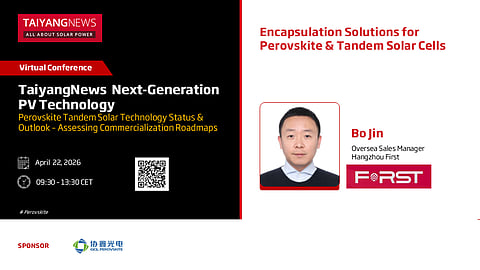
At the TaiyangNews Next-Generation PV Technology 2026 Virtual Conference, Bo Jin, Oversea Sales Manager at Hangzhou First, will speak on encapsulation solutions for perovskite and tandem solar cells – a quiet but critical piece of the reliability puzzle as the industry works to address long-term stability at scale.
Scheduled for April 22, 2026, from 09:30 to 13:00, participation in the event is free and can be done here.
Leading PV and energy storage manufacturer JinkoSolar, together with the Ningbo Institute of Materials Technology and Engineering under the Chinese Academy of Sciences, Soochow University, and the National University of Singapore, has published 3 research papers in Nature Energy.
The studies report progress in TOPCon and perovskite-TOPCon tandem technologies, including a certified 26.66% efficiency for an industrial-scale TOPCon cell on an M10 wafer using a dual-sided electrical synergy optimization strategy. A full-size bifacial TOPCon cell achieved a certified efficiency of 26.34%, while a monolithic perovskite-TOPCon tandem cell built on this platform reached 32.73% and retained 80% of its initial efficiency after 2,000 hours.
A third study reported a 32.76% efficiency perovskite-TOPCon tandem cell enabled by a dual-mode-coupled ligand strategy, with the device retaining 91% of its initial efficiency after 1,700 hours of continuous operation.
On the financial side, JinkoSolar recently released its FY2025 financial results, reporting a net loss of RMB 4.45 billion, with revenues and margins falling sharply due to low module prices and higher input costs (see JinkoSolar Ships 86 GW Modules In FY2025; Reports Annual Loss).
China Development Bank Financial Leasing (CDB Leasing) plans to acquire household PV power stations and associated equipment in Hunan and Hubei provinces for approximately RMB 650 million. The company signed agreements with 7 project companies wholly owned by Chint Anneng on April 17, 2026.
The acquisition will be funded through internal capital and/or bank loans, with CDB Leasing acting as the lessor under an operating lease model to third-party tenants, supporting its expansion in the household PV leasing segment.
Tianjin has released its 15th Five-Year Plan (2026-2030), targeting over 20 GW of non-fossil fuel power capacity, accounting for more than 50% of its total installed capacity by 2030.
The city plans to add 7 GW of new wind and solar capacity and deploy 2 GW of energy storage. The plan also highlights demand-side management, virtual power plant (VPP) development, expanded distributed PV applications, and integration of new energy across industrial, transport, and building sectors.
Releasing its financial results for FY2025, PV encapsulant film manufacturer HIUV New Materials reported annual revenue of RMB 1.16 billion, down 55.19% year-on-year (YoY). The company’s adjusted net loss for the period narrowed to RMB 485 million from RMB 519 million in 2024. This is in line with HIUV’s forecast in January (see China Solar PV News Snippets).
Revenue from PV encapsulant film sales fell 57.86% YoY to RMB 1.025 billion, with volumes declining 46.98% to 225 million m².
Silicon material manufacturer Hoshine Silicon reported 2025 revenue of RMB 20.499 billion, down 23.20% YoY, and a net loss of RMB 2.991 billion, compared to a net profit of RMB 1.74 billion in 2024. The net loss figure is near the low end of its forecast (see China Solar PV News Snippets)
The losses were primarily driven by its PV business. Due to weak demand and high inventory, the company halted polysilicon production and operated PV module lines at low utilization, resulting in shutdown losses. PV product revenue fell to RMB 899 million, accounting for 4.38% of total revenue.
Of the 400,000-ton polysilicon project initiated between 2022 and 2023, only 50,000 tons/year had been commissioned by the end of 2025, with utilization at 0% following the production halt.
