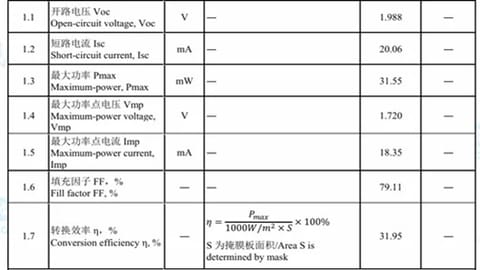


Solar PV and energy storage manufacturer Risen Energy has reported a conversion efficiency of 31.95% for its 1 cm² perovskite-heterojunction (HJT) tandem solar cell and an open-circuit voltage of 1.988 V.
The company attributed the performance gains to process optimization, including the formation of a high-quality self-assembled monolayer on the textured HJT surface, reducing defect density and improving charge transport.
Risen Energy said it is addressing industrialization challenges, such as large-area perovskite film deposition and long-term encapsulation, with the goal of commercialization in the coming years.
Risen Energy joins the flurry of record efficiency announcements of late, following Trinasolar and LONGi achieving 28% and 28.13% efficiencies with silicon-only cells. Specifically for perovskites, Huarou PV announced it achieved 31.73% efficiency with an all-perovskite tandem solar cell last week (see China Solar PV News Snippets).
Leading vertically integrated PV manufacturer LONGi has received approval to establish the National Photovoltaic Industry Quality Standard Laboratory, the first of its kind in China’s PV sector.
The lab will focus on quality control across the value chain, including product design, manufacturing, testing, and management, with emphasis on monocrystalline cells and modules.
LONGi said the lab will support research into key and forward-looking technologies, including cell performance characteristics, module safety evaluation, material processes, and the development of reliability standards.
Perovskite equipment manufacturer Puskai New Energy has produced a 300 × 300 mm flexible perovskite module on a PET substrate using a solvent-free chemical vapor deposition (CVD) process.
The module features low weight, high efficiency, and improved stability, targeting applications in consumer electronics, automotive PV, and space-based systems.
The company said the module has passed 1,000-hour damp heat testing (85°C/85% RH) at CPVT in accordance with IEC 61215 standards.
State-owned Beijing Energy Group has released the results of its 2026 PV module framework procurement announced in March, covering 4 GW, split equally between TOPCon and back-contact (BC) modules (see China Solar PV News Snippets).
LONGi, DMEGC Solar, and TCL Solar are prominent names among the 10 manufacturers that have secured contracts in the tender announced last month. The average winning price for TOPCon modules was RMB 0.751/W, while BC modules averaged RMB 0.805/W, indicating a premium of about RMB 0.05/W over TOPCon modules.
Bids ranged from RMB 0.72 to RMB 0.788/W for TOPCon and RMB 0.767 to RMB 0.827/W for BC modules.
Qinghai Province has issued a draft policy proposing capacity compensation for generation-side resources, including concentrated solar power (CSP) and grid-side energy storage, that do not receive new energy subsidies and are not subject to sustainable development price settlements.
The mechanism sets a provisional auxiliary power consumption rate of 21.53% for CSP and 10.39% for storage systems, with a uniform compensation standard of RMB 185/(kW·year).
Capacity payments will be calculated based on declared capacity and system coefficients, with costs allocated across industrial and commercial electricity users.
