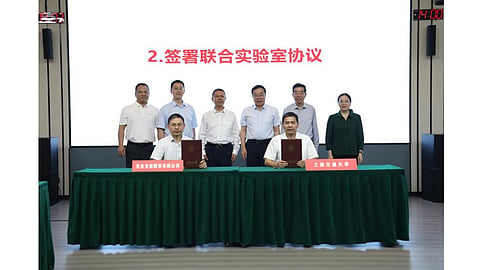


Leading PV and ESS manufacturer Trinasolar and its residential subsidiary TrinaPower have partnered with Shanghai Jiao Tong University to establish a Digital Energy Joint Laboratory.
Operating under the State Key Laboratory of PV Science and Technology, the facility will focus on PV-storage-hydrogen integration, green computing power, and smart energy systems to strengthen industry-university-research collaboration.
The partners said the laboratory will advance core digital energy technologies, accelerate the commercialization of research achievements, cultivate interdisciplinary talent, and participate in developing industry standards that support the digital transformation of the energy sector.
On the financial side, Trinasolar announced in July that it expects to significantly narrow its losses in H1 2026 (see China Solar PV News Snippets).
China's National Development and Reform Commission (NDRC) and National Energy Administration (NEA) have jointly released the ‘15th Five-Year Plan (2026-2030) for New Power System Development’, with the goal of establishing an initial new power system framework by 2030.
The plan aims for a total installed power generation capacity of 5.4 TW by 2030, with non-fossil energy accounting for 65% of installed capacity and 50% of electricity generation. It also targets more than 2.8 TW of renewable energy integration capacity while maintaining renewable energy utilization at around 90%, with differentiated regional utilization targets ranging from 85% to 95%.
By 2030, China plans to support 900 GW of distributed renewable energy through distribution networks, expand new energy storage capacity to 300 GW and pumped hydro storage to 160 GW, increase virtual power plant (VPP) regulation capacity to more than 50 GW, deploy more than 40 million charging facilities for 110 million electric vehicles (EVs), and raise hydropower and nuclear capacity to 410 GW and around 110 GW, respectively.
China targets an 8.5% reduction in carbon emissions per unit of floor area by 2030 compared with 2025 levels, and encourages the deployment of rooftop PV and solar thermal on all suitable existing public buildings (see China Solar PV News Snippets).
Digital platform provider Wen Cloud has launched Jing Xiaowei, an AI agent for the operation and maintenance of commercial solar-plus-storage assets.
The platform provides multi-site operational analysis, abnormality risk assessment, and natural language interaction. Using a PV and energy storage fault knowledge base, it can identify the root causes of equipment issues while estimating associated generation and revenue losses.
Wen Cloud said the AI agent forms part of its broader digital asset management platform, which currently manages more than 80 GW of renewable energy assets. According to the company, the AI-driven platform can reduce operating costs by around 30%.
Huizhou City in Guangdong Province has removed 49 centralized PV projects with a combined capacity of 7.58 GW from its development list.
The municipal government said the projects were canceled because construction had not progressed as required, development conditions could not be met, or the projects were no longer considered feasible.
The move follows Guangdong's shift toward provincial-level management and competitive allocation of utility-scale PV projects since 2023. During the same period, distributed PV has become the province's main source of solar capacity growth, with annual installations increasing from 5.7 GW in 2022 to 21.3 GW in 2025. In contrast, the share of centralized PV projects in annual additions declined from 41% to 24% during this period.
The China Electricity Council (CEC) forecasts that solar power will surpass coal-fired power in installed capacity during the third quarter of 2026, according to its 'Analysis and Forecast Report on National Power Supply and Demand for the First Half of 2026.'
By mid-2026, China's total installed power generation capacity had reached 4.04 TW, with non-fossil energy accounting for 2.52 TW, or 62.4% of the total. During the first half of the year, China added around 160 GW of new generation capacity, with wind and solar contributing approximately 110 GW.
The CEC expects total installed capacity to reach around 4.3 TW by the end of 2026, with combined wind and solar capacity accounting for about half of the country's total installed power generation capacity.
