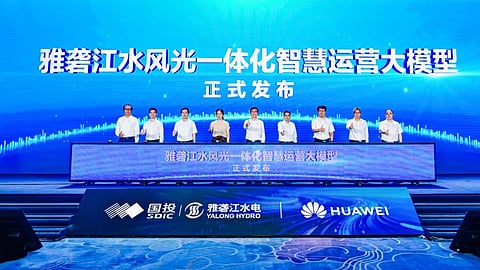


China has launched its first smart operation foundation model for integrated hydropower-wind-solar management. Jointly developed by SDIC Yalong River Hydropower Development Company, the National Climate Center, China Electric Power Research Institute (CEPRI), Huawei, and other partners, the system will support operations at the Yalong River integrated hydropower-wind-solar energy base. It runs on a high-altitude underground intelligent computing center powered entirely by hydropower, wind, and solar electricity, using the naturally low-temperature environment to reduce cooling energy consumption.
The model integrates satellite remote sensing, meteorological monitoring, hydrological information, and operating data from renewable energy plants. It can access real-time data from PV inverters, wind turbines, and hydropower equipment across the Yalong River basin, linking renewable energy forecasting with dispatch and operational decision-making.
The developers expect the accuracy of renewable resource forecasting at the Yalong River base to exceed 95%. The Yalong River integrated hydropower-wind-solar base has a planned capacity of 40 GW, with 23 GW already commissioned.
Solar solutions provider Trinasolar expects a net loss of RMB 180 million to RMB 360 million for H1 2026, significantly narrower than the RMB 2.92 billion loss reported a year earlier. Adjusted net loss is forecast at RMB 2.78 billion to RMB 2.96 billion, broadly in line with the RMB 2.96 billion recorded in H1 2025.
The company said ongoing supply-demand imbalances in the PV industry continued to pressure profitability, while business optimization improved operating performance. Orders from higher-value module markets increased steadily, while its energy storage and distributed system businesses remained profitable. Gains from previous equity disposals and fair value changes also contributed positively to interim results.
On the R&D front, Trinasolar recently reported that it has developed a silver-free TBC solar cell concept, along with UNSW and other partners, to replace silver metallization with lower-cost aluminum (see China Solar PV News Snippets).
Perovskite PV manufacturer UtmoLight has completed a 172-day field test of its perovskite modules at the National Wind-Solar-Storage-Transmission Demonstration Base in Zhangjiakou, Hebei Province. The project was connected to the grid in January 2026 using the company's 2.81 m² perovskite modules rated at 450 W.
According to the company, the modules operated under varying irradiation and temperature conditions from winter through summer, maintaining stable power generation with an average performance ratio approaching 100% and no significant degradation. These results are consistent with those previously observed in a separate test conducted at the Daqing base (see China Solar PV News Snippets).
UtmoLight said the measured temperature coefficient ranged from -0.001%/°C to -0.004%/°C, compared with the typical -0.2%/°C to -0.4%/°C for crystalline silicon modules, indicating lower power losses at high temperatures. The trial provides additional data on the long-term outdoor stability of perovskite modules.
Shandong Province has released new regulations to standardize green power direct supply projects, with priority given to multi-user projects in industrial and zero-carbon parks. Distributed PV projects may participate through centralized aggregation, while project operators must sign guaranteed-income agreements for at least 10 years with all rooftop PV stakeholders.
According to these regulations, annual self-consumption must account for at least 60% of renewable generation and at least 30% of total electricity consumption, with this requirement increasing to 35% by 2030. Grid exports are capped at 20% of generation, and projects are prohibited from feeding electricity back into the grid during periods of renewable curtailment. Offshore wind direct-supply projects are permitted a higher grid connection limit of 40%, while curtailed renewable generation from direct-supply projects will not count toward renewable energy utilization statistics.
Inverter manufacturer Solis (Ginlong Technologies) expects adjusted net profit for H1 2026 to decline 16.73%-25.84% year-over-year to RMB 406.96 million to RMB 456.96 million.
The company attributed the decline to foreign-currency losses, equity incentive expenses, and seasonal fluctuations in power generation and residential PV system performance due to weather conditions.
Despite the lower profit, Solis said demand for its high-power string inverters and energy storage inverters remained strong during the reporting period. It expects inverter shipments to increase by around 30% quarter over quarter in the third quarter. The company also reported a decline in profits for Q1 2026 (see China Solar PV News Snippets).
