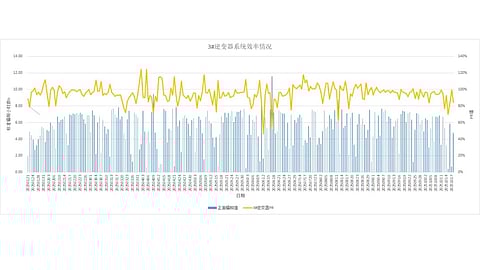


Perovskite maker UtmoLight announced it has won the bid for the Phase IV PV project at the National PV and Energy Storage Demonstration Platform (Daqing Base), led by SPIC. The company will supply 1 MW of large-format perovskite PV modules, each measuring 2.81 m². Earlier in 2025, Microquanta deployed 1 MW of 0.72 m² perovskite modules for Phase III of the same base. The company claims that operational data from the Phase III batch shows an average system Performance Ratio (PR) approaching 100%.
Earlier this month, UtmoLight announced that it has partnered with the University of New South Wales (UNSW) to jointly establish an International Joint Perovskite Laboratory (see China Solar PV News Snippets).
Leading solar and storage manufacturer Trinasolar announced the termination of Phase II (15 GW) of its originally planned 35 GW monocrystalline ingot facility. While Phase I (20 GW) has already been commissioned, the company decided not to proceed with Phase II due to a significant drop in silicon wafer prices.
Trinasolar plans to redirect approximately RMB 1.7 billion of the remaining raised funds to a new ‘Distributed Smart PV Power Station Project’. With a total investment of RMB 3.4 billion, the new project aims to construct 245 MW of distributed solar power projects in Jiangsu and Zhejiang provinces, with operation expected to commence by the end of 2026.
The Yunnan Tongwei Analysis and Testing Center has passed the on-site assessment by the China National Accreditation Service for Conformity Assessment (CNAS). The audit team conducted a comprehensive review of the management system, technical capabilities, and personnel operations for both Phase I and Phase II of the center, granting it recommended accreditation status. Tongwei stated that passing this assessment indicates that Yunnan Tongwei’s quality management and technical capabilities in PV testing have reached international standards, and that its test reports will now be recognized internationally.
On the financial side, Tongwei recently released its FY2025 financial results forecast, projecting an adjusted net loss of RMB 9.0 billion to RMB 10.0 billion (see China Solar PV News Snippets).
PV encapsulant manufacturer Cybrid has released its financial results forecast for FY2025, projecting an adjusted net loss of RMB 240 million to RMB 286 million, compared to a loss of RMB 286.14 million in 2024. The company stated that in the PV sector, backsheet shipments contracted due to market demand, while the encapsulation material business faced price drops driven by intense supply-side competition, resulting in declines in both sales volume and profitability. Additionally, continued R&D and market investment in non-PV sectors impacted current profits. The company also made impairment provisions for inventories and accounts receivable.
The Ministry of Industry and Information Technology (MIIT), the National Energy Administration (NEA), and 3 other departments have jointly issued a document titled ‘Guidance on Building Zero-Carbon Factories’. It sets phased targets: selection will begin in 2026, and by 2027, a batch of zero-carbon factories will be established first in key industries such as solar photovoltaics, lithium batteries, and new energy vehicles (NEVs). By 2030, the scope will expand to other sectors.
The policy emphasizes the critical role of solar and storage, explicitly encouraging factories to vigorously develop distributed PV and dispersed wind power based on local conditions. It also supports qualified factories in building industrial green microgrids that integrate PV, wind, new energy storage, and heat pumps to achieve efficient multi-energy complementarity.
