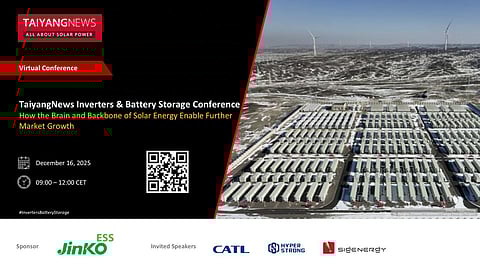


As solar drives the energy transition and its share quickly grows, so do system-level challenges in advanced markets, as grid expansion can’t keep pace and midday production peaks don’t align with demand profiles. The consequences are increasingly negative electricity prices, power curtailment, and decreasing solar capture prices. The short-term flexibility solutions are smart inverters and battery storage.
Modern inverters don’t just convert power; the ‘brains’ of the solar system have evolved into intelligent, multi-tasking hubs. They are increasingly becoming active participants in grid management, not following the grid, but forming it.
Batteries are equally critical. Solar batteries are key to breaking the glass ceiling that limits further solar growth in advanced solar markets, unlocking their potential to deliver energy not just when the sun shines, but also at different times.
Sponsored by JinkoSolar, TaiyangNews will host the 2nd edition of the TaiyangNews Inverters & Battery Storage Conference on Tuesday, December 16, 2025, from 09:00 to 12:00 CET. It will feature top experts discussing how advanced inverters and battery storage are shaping resilient, future-proof solar energy systems.
Register for free here.
LONGi, one of the largest vertically integrated PV manufacturers, announced that it has decided to cancel its plan to issue Global Depositary Receipts (GDRs) and list on the SIX Swiss Exchange.
The company first unveiled the proposal in June 2023, stating that the planned GDR issuance would raise a maximum of RMB 19.996 billion to support several major projects, including a 46 GW mono-silicon ingot and wafer facility in Ordos, a 30 GW mono-cell project in Ordos, a 6.6 GW ingot facility and 2.8 GW module plant in Malaysia, and a 3.35 GW cell project in Vietnam.
In its latest announcement on December 10, LONGi said the decision was made after considering multiple factors and the company’s overall situation. Notable among the companies that have cancelled fundraising plans in recent months is GCL SI, which cancelled its plans to raise ~RMB 4.8 billion for a cell manufacturing capacity expansion (see China Solar PV News Snippets).
PV paste manufacturer DKEM released an update regarding the patent infringement dispute between its subsidiary, Solamet, and Gonda (see China Solar PV News Snippets).
In November, Solamet filed a lawsuit accusing Gonda of infringing its invention patent (Patent No. 201180032359.1), with claims totaling RMB 200 million. Gonda subsequently countersued, alleging ‘malicious intellectual property litigation’ and seeking RMB 5 million in damages, while also challenging the court’s jurisdiction.
According to DKEM’s disclosure on December 10, the Zhejiang High People’s Court has rejected the jurisdiction objection raised by Gonda. The patent case will continue to be heard by the same court. The first-instance trial is ongoing and has not yet entered the hearing stage.
GCL System Integration (GCL SI), the cell and module manufacturing arm of GCL Group, has announced that its GTC perovskite tandem solar cell has achieved a power conversion efficiency of 33.31%, a result certified by China’s National Photovoltaic Quality Inspection Center (CPVT).
The GTC tandem cell combines a back-contact (BC) silicon cell with a perovskite top cell. According to GCL SI, key technical breakthroughs include sub-micron crystalline silicon surface optimization and ultra-thin polysilicon, which significantly enhance spectral utilization; a ‘cation-mixing’ strategy paired with precise iodine-bromine ratio control to improve current matching; and advanced interface engineering, such as multi-site passivation, to stabilize grain boundaries.
China’s Chongqing province has published the results of its first mechanism tariff auction, selecting 3,882 projects.
Solar PV projects accounted for the overwhelming majority of this total, or 3,865, with a total allocated mechanism electricity volume of 1.70 billion kWh, at a mechanism tariff of RMB 0.3963/kWh.
The remaining 17 are wind power projects, which received a combined mechanism electricity volume of 2.07 billion kWh, with a mechanism tariff of RMB 0.3961/kWh.
All projects will apply the awarded mechanism tariffs for a duration of 12 years.
