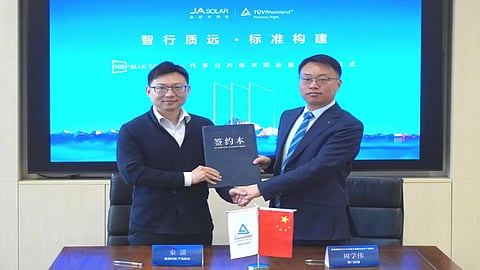


Solar manufacturer JA Solar has signed a Framework Agreement on Joint Validation of Next-Generation Multi-Cut Cell Technology with TÜV Rheinland. Under the agreement, JA Solar will provide product data, cell and module structures, manufacturing process details, and test samples to support TÜV Rheinland’s work on developing testing standards, conducting verification tests, advancing certification procedures, and performing quality assessments related to multi-segmentation technology.
The cooperation aims to jointly establish a comprehensive evaluation framework for multi-segmented cell technology and ultimately set a reference model for the industry.
JA Solar recently released the industry’s ‘first’ Desert-Gobi-Wasteland PV Solution White Paper, developed jointly with TÜV NORD (see China Solar PV News Snippets).
Electrical contact materials producer Fudar Alloy has decided to terminate its planned acquisition of solar cell silver paste manufacturer Gonda. The transaction, first announced in July this year, involved Fudar Alloy’s intention to acquire a 51% stake in Gonda’s equity, which would have made Gonda a controlling subsidiary (see China Solar PV News Snippets).
In the months following the announcement, Gonda became involved in a patent dispute with another solar silver paste supplier, Solamet. Gonda had filed a countersuit in Zhejiang High People’s Court, alleging ‘malicious intellectual property litigation’. According to a recent disclosure from Solamet’s parent DKEM, the court rejected the jurisdiction objection raised by Gonda (see China Solar PV News Snippets).
In its latest announcement, Fudar Alloy stated that, after considering the current market environment and changes in Gonda’s situation, the company has decided to cancel the acquisition.
The Henan Provincial Development and Reform Commission has released an implementation plan for the market-oriented reform of on-grid electricity pricing for renewable energy. According to the plan, starting January 1, 2026, electricity generated by renewable energy projects across the province – including solar PV and wind – will, in principle, fully participate in the power market. Projects may submit volume-price bids or accept market-clearing prices.
The policy distinguishes projects based on a cutoff date of June 1, 2025. For projects commissioned before the cutoff date, distributed PV and poverty-alleviation PV projects will have 100% of their generation included in the mechanism-based electricity volume, while centralized projects will have 80% included, with the corresponding mechanism price aligned with Henan’s current benchmark coal-fired power tariff of RMB 0.3779/kWh. Projects commissioned on or after June 1, 2025, may voluntarily participate in competitive bidding to obtain mechanism-based electricity volumes and prices.
The Sichuan Provincial Development and Reform Commission has released a draft for public consultation on the management of green power direct-connection projects. The document defines direct-connection lines as dedicated power lines that directly supply green electricity from a power source to a single end user, with the objective of meeting enterprises’ green electricity demand and improving local consumption of renewable energy.
Under the draft rules, the annual self-consumed electricity generated by renewable energy in such projects must account for no less than 60% of total available generation, and no less than 30% of total electricity consumption, with the self-consumption share required to increase progressively to at least 35% before 2030. The document also stipulates that green power direct-connection projects should not feed electricity back into the public grid before Sichuan’s power spot market enters continuous operation.
Guangdong Province has announced the results of its first mechanism-based electricity price auction for renewable energy projects. The bidding targeted distributed solar PV projects scheduled to be commissioned, or committed to commissioning, between June 1, 2025, and October 31, 2026, and not previously covered by the mechanism.
A total of 11,588 distributed PV projects were selected, representing an installed capacity of 5.24 GW. The total mechanism-based electricity volume allocated reached 4.43 billion kWh, with a unified mechanism price set at RMB 0.36/kWh. The execution period for this mechanism-based price is 12 years.
