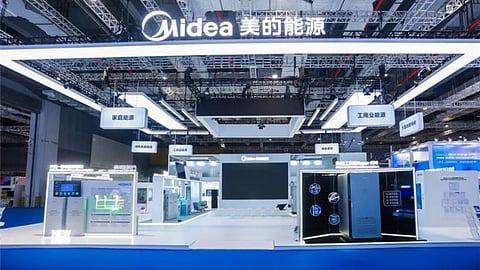


Chinese home appliance giant Midea Group has recently established the New Energy Business Division, integrating the New Energy Products Company and the Energy Technology Company, which were previously under its Industrial Technology Business Unit. Jianguo Wang, Executive President of Midea Group, will concurrently serve as President of the new division. Chinese local media commentary noted that the establishment of the New Energy Business Division signals Midea’s intention to position new energy as a key second growth engine.
To date, Midea Group has built a portfolio of new energy-related brands, including Midea Energy, Hiconics, and Clou Electronics, with business activities spanning distributed PV project development and the manufacturing of inverters and energy storage products. Earlier this month, Midea PV launched M-ECOLUX VILLA, a PV solution for the residential villa market that uses AIKO’s ABC modules.
State Grid Corporation of China, one of the country’s 2 major grid operators, has commissioned a ±800 kV ultra-high-voltage direct current (UHVDC) transmission project with a total investment of RMB 33.40 billion.
The line originates in the upper reaches of the Jinsha River and passes through Tibet, Sichuan, Chongqing, and Hubei, terminating at the Huangshi Daye converter station in Hubei Province, with a total transmission distance of nearly 1,900 kilometers. The project is also described as China’s first UHV transmission line to penetrate deep into the Tibetan Plateau.
According to State Grid, the project will support the large-scale development of the integrated hydropower, wind, and solar energy base in the upper Jinsha River region. Once fully operational, it is expected to transmit nearly 40 billion kWh of clean electricity annually from upstream renewable energy bases to Central China.
Perovskite maker RenShine Solar announced that its self-developed perovskite-silicon tandem module has achieved a certified power conversion efficiency of 31.7% on an area of 384.02 cm², as verified by TÜV SÜD. According to the company, this result sets a new world record for 4-terminal tandem modules at this size.
Last month, the company reported another efficiency milestone, with its 2-terminal perovskite/silicon tandem module achieving 28% efficiency on a 386.13 cm² area. Separately, it also reported achieving 24% efficiency on a 30 × 40 cm single-junction perovskite module while its large-format 1.2 m × 0.6 m perovskite module reached a full-area efficiency above 22% (see China Solar PV News Snippets).
Xinjiang has released the results of its second round of mechanism-based electricity price bidding. The original planned bidding volume was 19.83 billion kWh, with a bidding price range of RMB 0.15-0.262 per kWh (see China Solar PV News Snippets).
According to the results, a total of 19.83 billion kWh was allocated. 16 solar PV projects secured 6.76 billion kWh at a mechanism-based price of RMB 0.150 per kWh, while 24 wind power projects were awarded 13.06 billion kWh at RMB 0.210 per kWh. All projects will apply the awarded prices for a period of 10 years.
Notably, the solar PV price of RMB 0.150 per kWh is significantly lower than the RMB 0.235 per kWh recorded in the first round and represents the lowest price achieved across all provincial mechanism-based electricity price bidding rounds to date.
Compared with Xinjiang, Shanxi Province recorded substantially higher prices in its first round of mechanism-based electricity price bidding for renewable energy projects. A total mechanism-based electricity volume of 5.51 billion kWh was offered in this round.
In total, 4,963 renewable energy projects were selected, with an aggregate allocated volume of 5.46 billion kWh. Of this total, 4,955 solar PV projects were awarded 3.975 billion kWh at a price of RMB 319.990 per MWh, while 8 wind power projects secured 1.48 billion kWh at a price of RMB 284.660 per MWh.
