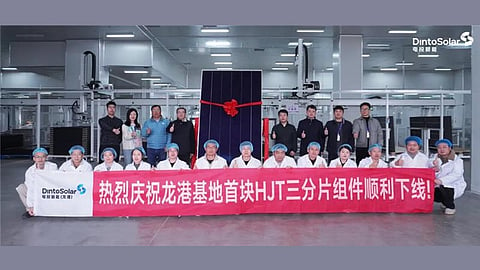


Heterojunction (HJT) manufacturer DintoSolar, a SPIC subsidiary, announced that its production base in Longgang, Zhejiang Province, has rolled out its first high-efficiency 3-cut-cell HJT module.
The product integrates zero busbar (0BB), 3-cut cells, flexible interconnection, and PIB encapsulation technologies, achieving a maximum power output of 765 W and conversion efficiency above 24.63%, according to the company.
Last month, DintoSolar announced plans to invest RMB 300 million in Suining, Sichuan Province, to build a crystalline-silicon copper-grid HJT R&D and pilot platform, including a 600 MW pilot line for cells and modules, as well as a national-level module testing laboratory (see China Solar PV News Snippets).
Power battery manufacturer CATL has terminated its proposed acquisition of Huawei Digital Power after negotiations stalled over valuation, according to Chinese financial media Sina Finance. Huawei reportedly valued the business at RMB 400 billion, compared with CATL’s offer of RMB 150-200 billion. An internal notice dated February 5 confirmed the unit is no longer for sale.
Recent trademark filings, including ‘Huawei Energy’ and ‘Huawei Digital Power’, span categories such as scientific instruments, transport equipment, and machinery, indicating potential expansion of Huawei’s energy business beyond its established inverter and energy storage segments.
In November 2025, CATL signed a 10-year strategic cooperation agreement with HyperStrong to supply 200 GWh of cells until December 31, 2028, and to develop the collaboration beyond supply in the longer term (see China Solar PV News Snippets).
China’s National Energy Administration (NEA) reported that the country added 452 GW of renewable capacity to the grid in 2025, representing 83% of total newly installed power capacity. Solar PV led the additions with 317 GW (2 GW more than the 315 GW announced in January), including 164 GW of centralized PV and 153 GW of distributed PV. It was followed by 120 GW of wind, 12.15 GW of hydropower, 1.51 GW of biomass, and 940 MW of concentrated solar power (CSP).
China’s cumulative renewable capacity reached 2.34 TW (~60% of the power mix) by the end of 2025, while combined wind and solar capacity rose to 1.84 TW (47%), surpassing thermal power for the first time. Renewable generation totaled 3,990 TWh (~38% of electricity output), with the NEA stating that new renewable generation met the entire net increase in power demand.
A new company, Yunnan Energy Group Co., Ltd., has taken shape in Kunming following the merger and restructuring of Yunnan Energy Investment Group and Yunnan Coal Industry Group. As of the end of 2025, the entity reported total assets of RMB 269 billion, with equity power installed capacity exceeding 26 GW and coal production capacity above 27 million tons.
The group outlined plans to develop an integrated energy portfolio spanning wind, solar, hydro, thermal, and storage, alongside source-grid-load-storage systems, positioning itself as a national-level green energy enterprise.
The Shanghai Stock Exchange (SSE) has issued a regulatory warning to Shuangliang Eco-Energy regarding information disclosure related to a reported order tied to SpaceX’s Starship launch base expansion. The company had stated via its WeChat account that it secured an order for 12 high-efficiency heat exchangers, triggering a daily limit-up in its share price.
Subsequent filings clarified that Shuangliang is a non-exclusive indirect supplier rather than a direct SpaceX partner, and that the order represented ~0.11% of its 2024 revenue with no material financial impact. The SSE cited the use of non-statutory disclosure channels and omission of key details, including supply structure and limited earnings contribution, as potentially misleading to investors.
