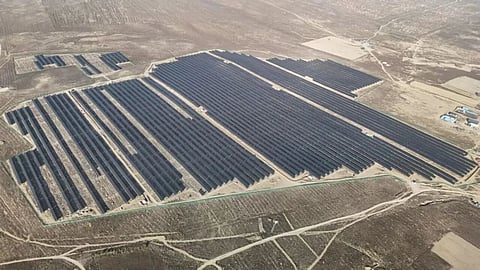


The 500 MW Dalad Banner Sand Control and PV Integration Project in Inner Mongolia has achieved full-capacity grid connection, exclusively utilizing LONGi’s Hi-MO 9 back-contact (BC) modules. LONGi identifies the facility as the largest single-site PV project currently operating in China to deploy BC technology.
The project is designed to combine power generation with desertification control and is expected to generate an average of 852 million kWh annually. It also supports ecological restoration across 400 hectares of land.
At the TaiyangNews High-Efficiency Solar Technologies 2025 Conference, LONGi outlined how back-contact design addresses fundamental efficiency and reliability constraints in conventional cell architecture (see LONGi Presents BC As The Next Efficiency Platform).
According to data from the National Energy Administration (NEA), China added 316.57 GW of new grid-connected PV capacity in 2025. Of the total, utility-scale projects accounted for 163.57 GW, commercial and industrial (C&I) systems for 107.05 GW, and residential installations for 45.95 GW. The 3 segments achieved year-over-year growth rates of 2.62%, 20.79%, and 55.5%, respectively.
Xinjiang led new additions, almost entirely utility-scale, with 34.15 GW, followed by Jiangsu at 28.04 GW, driven by 18.32 GW of distributed PV. Guangdong, Shandong, and Yunnan added 21.33 GW, 18.71 GW, and 17.63 GW, respectively. By the end of 2025, Shandong ranked highest in cumulative installed capacity with 94.85 GW, followed by Xinjiang (90.90 GW) and Jiangsu (89.68 GW).
Nationally, cumulative grid-connected PV capacity reached 1.20 TW, comprising 666.91 GW of utility-scale, 327.17 GW of C&I, and 205.83 GW of residential capacity.
Earlier this month, NEA reported that China added 452 GW of renewable capacity to the grid in 2025 (see China Solar PV News Snippets).
Leshan Xinneng New Material Technology Co., Ltd., a subsidiary of GCL Tech, plans to construct a lithium iron phosphate (LFP) cathode material facility in Leshan, Sichuan Province. The project will cover approximately 308 mu and include 2 production workshops and supporting facilities. The company plans to install 12 production lines in 2 phases, each with a capacity of 200,000 tonnes per year of LFP cathodes, bringing the total planned capacity to 400,000 tonnes per year. These LFP cathodes serve as a critical component in the manufacturing of LFP batteries.
Solar equipment manufacturer SC Solar has shipped its automatic electromagnetic heating multi-layer laminator to an overseas client, which it claims to be the first global commercial deployment of such a system. Developed in-house, the equipment features 8 vacuum chambers and applies electromagnetic induction heating combined with a 3-stage pressing process.
According to the company, the system reduces floor space requirements by 50%, increases production capacity by 33%, lowers energy costs by ~32%, and improves energy efficiency per unit area by ~60% compared with conventional laminators.
In June last year, SC Solar announced its plans to acquire a 1.5523% stake in Runergy through the purchase of new shares (see China Solar PV News Snippets).
Ren Yuzhi, Director of the Planning Department at the NEA, outlined priorities for the 15th Five-Year Plan (2026-2030), including preliminary establishment of a new-type energy system and positioning new energy as the primary source of installed power capacity by 2030. Among the plan’s targets are raising the share of non-fossil energy consumption to 25% and increasing electricity’s share of terminal energy consumption by 1 percentage point annually.
Planned measures include continued development of large-scale wind and solar bases in northern China; integrated hydro-wind-solar bases in the southwest; offshore wind projects; and multi-energy hubs combining wind, solar, hydrogen, ammonia, methanol, and CSP. The plan also calls for accelerated distribution grid upgrades to accommodate distributed renewables and electric vehicle charging infrastructure.
