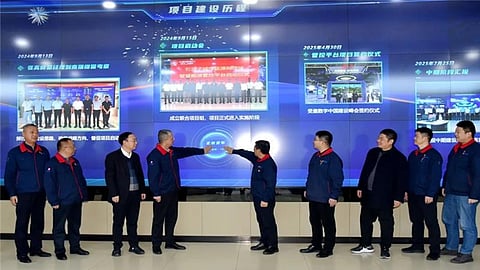


A smart energy management platform developed by state-owned power developer Zhongxin Power Construction Group Co., Ltd. has officially entered operation as part of the Shihezi source-grid-load-storage (SGLS) integrated demonstration zone in Xinjiang. The project is dubbed the first city-level SGLS integrated demonstration zone in China.
Shihezi operates China’s only independent power system that integrates power generation, transmission, and dispatching. Zhongxin Power Construction Group launched the demonstration zone leveraging this advantage, including 5 GW of solar PV projects, supported by 5 energy storage power stations with a combined daily energy storage capacity of 305 MWh.
Energy storage solutions provider RelyEZ has submitted an application for listing on the Hong Kong Stock Exchange. Founded in 2019, the company focuses on energy storage system (ESS) solutions and products, primarily serving utility-scale and C&I applications.
According to its prospectus, RelyEZ recorded revenues of RMB 880 million in the first 3 quarters of 2025, with a total profit of RMB 70.9 million. Utility-scale ESS solutions accounted for 92.7% of revenue, while ESS product sales contributed 6%.
As of September 2025, the company operated 3 manufacturing facilities in Jiangsu and Yunnan, with a total annual capacity of 6.8 GWh. According to Frost & Sullivan data, RelyEZ ranked 5th globally among providers of full life-cycle energy storage asset solutions in 2024, with shipments of 3.7 GWh.
Solar cell and module manufacturer EGING PV expects an adjusted net profit loss of RMB 447.5 million to RMB 597.5 million in 2025, compared with a loss of RMB 2.09 billion in the previous year. In its 2025 annual profit warning, the company said that while losses have narrowed, its net assets are expected to be a negative RMB 68 million to RMB 130 million by year-end, indicating insolvency.
As of the end of 2025, EGING PV operates 3 GW of PERC cell capacity, 7.5 GW of TOPCon cell capacity, and 9.5 GW of module capacity, but all cell production lines have been shut down. Module capacity utilization in 2025 was only around 35%. The company currently has no controlling shareholder or de facto controller, and faces liquidity pressure and credit deterioration. Furthermore, it has warned of potential delisting risk and the likelihood of being placed under *ST status.
In November 2025, EGING PV reported that its losses for the first 9 months of 2025 had more than halved year-over-year (see China Solar PV News Snippets).
The Yunnan provincial government has set out plans to accelerate manufacturing upgrading and industrial restructuring toward mid- to high-end segments. For the PV industry, the policy supports industry consolidation and M&A among leading companies to build major domestic manufacturing bases. By 2027, Yunnan aims to achieve PV manufacturing capacity utilization of at least 70%.
Currently, the province hosts multiple PV manufacturers, including LONGi, JA Solar, Solargiga Energy, and Unigrace, covering wafers, cells, and module manufacturing.
