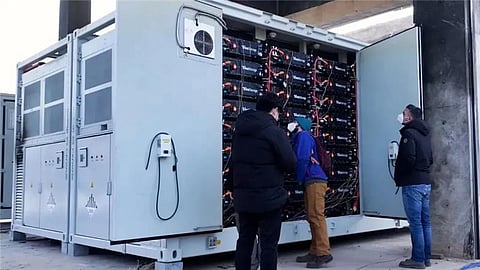


Trina Storage, the energy storage subsidiary of Trinasolar, announced that its flagship product, Elementa 2 Pro, has successfully completed a large-scale combustion experiment. Beyond meeting international standards such as CSA, NFPA, and UL 9540A (2025 edition), the test pushed safety boundaries by reducing unit spacing to 10 cm and triggering combustion with temperatures exceeding 1,300°C. Data showed the system maintained notable fire isolation and thermal protection: maximum temperatures in adjacent units remained low (back-to-back <43.9°C, side-by-side <23.9°C, face-to-face <28.6°C), all far below valve-opening thresholds. No thermal propagation occurred throughout the process, validating the system-level safety redundancy in Trina Storage’s structural design and material application.
Recently, Trina Storage signed a cooperation agreement with Hebei Jidian New Energy Co., Ltd., for the Leting 100 MW/400 MWh standalone energy storage project (see China Solar PV News Snippets).
The Yunnan Provincial Development and Reform Commission has announced that the province will optimize its time-of-use (TOU) electricity price policy starting March 1, 2026. The new regulation clarifies a dual-track pricing mechanism: Commercial and Industrial (C&I) users participating directly in electricity market trading will no longer adhere to government-set TOU prices. Instead, their pricing will fully follow market rules (mid- to long-term and spot markets) to reflect supply-and-demand sensitivity.
Large industrial users and general C&I users with 100kVA or more who purchase power through the grid agency will continue to pay government-prescribed TOU prices. The peak-valley periods remain unchanged, with the 12:00-16:00 solar generation window designated as a valley period to encourage consumption and renewable absorption. The peak-flat-valley price ratio remains 1.5:1:0.5, with critical peak pricing temporarily suspended.
Skyworth Group has revealed its plan to spin off its core asset, Skyworth PV, listing it separately on the Main Board of the Hong Kong Stock Exchange without issuing new shares. Concurrently, Skyworth Group will initiate privatization and delisting procedures, as well as a share buyback plan.
According to financial data, Skyworth PV is the primary growth engine for the group, recording revenues of over RMB 20.10 billion in 2024 and a net profit of RMB 793 million. The business covers distributed PV, smart O&M, and virtual power plants (VPP). As of 2025, Skyworth PV claims to have operated more than 27 GW of solar projects.
The National Bureau of Statistics (NBS) released its monthly report on industrial value-added for December 2025, covering industrial enterprises above the designated size (annual revenue ≥ RMB 20 million). In December, solar cell output reached 74.44 GW, a slight increase from November 2025 but a 9.7% decline compared to December 2024. For the full year of 2025, solar cell production totaled 832.74 GW, representing a year-over-year increase of 7.6%. Previously, NBS had reported 761 GW of solar cell output for 11M 2025 (see China solar PV News Snippets).
Additionally, these enterprises generated a total of 9,715.9 billion kWh from January to December, up 2.2% YoY. Solar and wind power generation recorded 572.6 billion kWh (+24.4%) and 1,053.1 billion kWh (+9.7%), respectively.
HY Solar released its FY2025 financial results forecast, projecting an adjusted net loss of RMB 250 million to RMB 310 million. This represents a substantial improvement compared to the RMB 2.69 billion loss recorded in the same period last year.
The announcement attributed the recovery to the company’s vertical integration strategy, which effectively mitigated price fluctuations across the supply chain. However, factors including supply-demand mismatches and rising silver paste prices in the fourth quarter continued to pressure production costs, resulting in a continued net loss for the year. Management emphasized that the company has maintained an asset-liability ratio below 60%, ensuring strong risk resistance.
