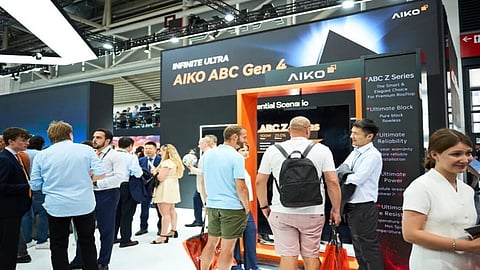


Leading back-contact (BC) cell and module manufacturer AIKO has secured a contract to supply 677.99 MW of modules for Section II of Zhejiang Provincial Energy Group's 1.2 GW solar power base in the Tengger Desert, Gansu Province. The project is the largest centralized PV installation in China to date for BC technology.
AIKO will supply its ABC modules, which feature TÜV Rheinland Grade A anti-shading certification and a dust-resistant short-edge frame design developed for high-temperature desert environments.
The project serves two purposes – power generation and sand control – that improve land utilization. According to the developer, the higher efficiency of BC modules will increase power density and help reduce the levelized cost of electricity (LCOE) under desert operating conditions.
AIKO recently announced it has partnered with Tianjin Binhai New Area Construction & Investment Group and China Railway 18th Bureau Group to invest $275 million in a land-based Atlantic salmon farming project (see China Solar PV News Snippets).
China's Ministry of Finance, General Administration of Customs, and State Taxation Administration have announced new battery consumption tax policies, ending the consumption tax exemption for solar cells in place since 2015.
Solar cells will be subject to a 2% consumption tax from April 1, 2027, increasing to 4% from April 1, 2028.
From September 1, 2026, mercury-free primary batteries, nickel-metal hydride batteries, lithium primary batteries, lithium-ion batteries, and vanadium redox flow batteries will also be subject to a 2% consumption tax, which will rise to 4% from September 1, 2027.
Sodium-ion batteries, solid-state batteries, fuel cells, and emerging PV technologies, including perovskite, tandem, and gallium arsenide solar cells, will remain exempt through December 31, 2028, provided they comply with relevant national standards and certification requirements.
Chinese energy developer Beijing Jingneng Power plans to raise up to RMB 5 billion through a private placement, including RMB 1.16 billion for its 1.5 GW integrated energy base combining wind, solar, fire, and storage in Ulanqab, Inner Mongolia.
The RMB 7.148 billion project will comprise 1.2 GW of wind power and 300 MW of solar PV. It will integrate with the company's existing coal-fired power assets to form a multi-energy complementary system.
Once completed, electricity generated by the project will be transmitted to the Beijing-Tianjin-Hebei region via dedicated transmission corridors.
Leading solar manufacturer LONGi expects its adjusted net loss for H1 2026 to range between RMB 3.7 billion and RMB 4.2 billion, widening from a net loss of RMB 3.304 billion in H1 2025.
The company attributed the weaker performance to persistent supply-demand imbalances across the PV industry, lower domestic installations following the 2025 high installation base, constrained renewable energy consumption capacity, lower module sales, weak operating rates, compressed margins, investment losses from associates, and foreign exchange losses.
LONGi said it will accelerate its transition to BC technology, expand BC product deployment, advance ACM cell mass production, and strengthen integrated solar-plus-storage solutions and overseas localization.
On the product development side, LONGi recently announced achieving 35.5% conversion efficiency for its independently developed crystalline silicon-perovskite tandem solar cell (see China Solar PV News Snippets).
Solar and ESS manufacturer JA expects an adjusted net loss of RMB 2.75 billion-RMB 3.25 billion for H1 2026, compared with an adjusted net loss of RMB 2.29 billion in the same period last year.
The company said continued oversupply across the PV value chain intensified competition during the reporting period. It also cited the cancellation of export tax rebates, rising international trade frictions and logistics disruptions affecting some overseas orders, resulting in additional fulfillment-related claims.
JA added that its module business remained loss-making during the first half of the year.
