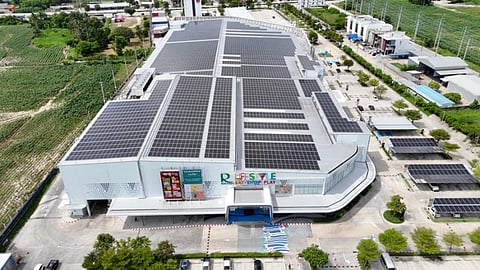


JinkoSolar has launched its Sunny 365 smart PV-storage solution for commercial and industrial (C&I) applications, targeting retail stores and other commercial settings with an integrated package covering PV, energy storage, intelligent energy management, and operations services.
The solution combines JinkoSolar’s Tiger Neo 3.0 n-type TOPCon modules, SunGiga G2 liquid-cooled ESS, AI-based energy scheduling algorithms, and the company’s Cloud platform to coordinate PV generation, energy storage, and electricity consumption.
JinkoSolar has introduced standardized configurations for different retail scenarios, including a 3.3 MW PV system with a 2.088 MWh ESS for large warehouse supermarkets and an 880 kW PV system with a 522 kWh ESS for medium-sized chain stores. The solution has already been deployed in overseas projects, including the 3.16 MW Robinson shopping mall installation in Thailand, featuring a 215 kWh liquid-cooled ESS.
Jinko Power, the renewable energy development arm of JinkoSolar, recently signed a strategic cooperation agreement with AI software company SenseTime to jointly develop ‘Green Power + Intelligent Computing’ projects (see China Solar PV News Snippets).
China has released an updated national standard, Norm of Energy Consumption per Unit Products of Polysilicon and Germanium (GB 29447—2026), which will take effect on January 1, 2027, replacing the 2022 version.
The standard introduces three energy consumption tiers for polysilicon production. Under the modified Siemens process, comprehensive energy consumption limits are set at 5.0 kgce/kg, 5.5 kgce/kg, and 6.3 kgce/kg for Levels 1, 2, and 3, respectively. For the silane fluidized bed process, the corresponding limits are 3.6 kgce/kg, 4.0 kgce/kg, and 4.6 kgce/kg.
Existing polysilicon producers must meet the Level 3 requirement, while new and expanded projects must achieve Level 2. According to the Chinese PV media outlet Zhihui PV, only about 45% of existing polysilicon capacity meets the 6.3 kgce/kg threshold, and the new standard is expected to accelerate the phase-out of less-efficient production capacity.
State-owned energy developer CHN Energy has commenced operations at its Shanxi Renewable Energy Trading Center, the group's first regional renewable energy trading platform.
The center integrates renewable energy resources from the company's solar and wind projects in Shanxi to support regional renewable energy trading and management. It has also established a ‘daily planning and daily review’ mechanism to improve renewable energy forecasting, optimize trading strategies, and increase renewable energy utilization.
The center is also developing an intelligent trading platform and strengthening risk management throughout the trading process. The platform is expected to provide operational experience for centralized renewable energy management and market-based trading in other regions.
Last month, CHN Energy fully commissioned the Rudong integrated solar-hydrogen-storage project, billed as the largest of its kind in China (see China Solar PV News Snippets).
Polysilicon manufacturer Hoshine Silicon expects to report attributable net profit of RMB 320 million to RMB 380 million for the first half of 2026, while adjusted net loss is forecast in the range of RMB 28 million to RMB 33 million. Both represent significant improvements from attributable and adjusted net losses of RMB 397 million and RMB 533 million, respectively, in H1 2025.
The company attributed the improvement to higher utilization rates, increased production and sales of industrial silicon, and stronger supply-demand conditions in the organosilicon market, which supported higher product prices and improved gross margins.
Hoshine Silicon said the difference between attributable net profit and adjusted net profit was mainly due to non-recurring gains related to the optimization of supplier payment arrangements and equipment replacement activities.
