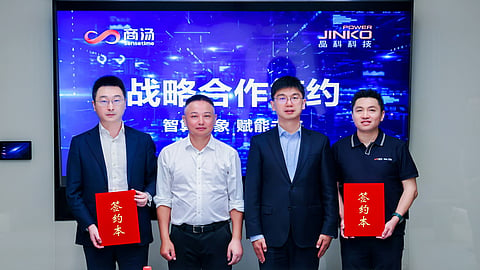


Jinko Power, the renewable energy development arm of JinkoSolar, signed a strategic cooperation agreement with AI software company SenseTime during the World AI Conference (WAIC) to jointly develop ‘Green Power + Intelligent Computing’ projects.
The partnership will focus on green power direct supply, power-computing integration, source-grid-load-storage systems, and the international deployment of renewable energy and AI solutions.
Jinko Power said it will leverage its global renewable energy portfolio and project development capabilities to provide low-carbon electricity for data centers, expanding its role from a power producer to an integrated green computing and energy service provider. SenseTime will contribute its AI algorithms and computing infrastructure, with the two companies collaborating across power supply, asset operations and investment.
In April, Jinko Power signed an agreement to build a 1 GW computing center for a total investment of RMB 24.5 billion (see China Solar PV News Snippets).
China's major industrial enterprises produced 381.18 GW of solar cells in the first half of 2026, down 14.2% year on year, according to the National Bureau of Statistics.
June production totaled 74.2 GW, a decline of 8.4% from a year earlier, but an improvement from the 25.6% YoY decline in April 2026 (see China Solar PV News Snippets).
Despite lower manufacturing output, solar power generation continued to grow. Electricity generation from solar reached 339.4 billion kWh in H1 2026, up 12.3% year on year, while wind power generation declined 1.9% to 559.1 billion kWh.
China's National Energy Administration (NEA) has launched a nationwide pilot program for rural microgrids to accelerate the deployment of distributed solar PV, wind power, and energy storage.
The initiative covers three pilot categories: utility-led residential projects, market-led commercial & industrial (C&I) microgrids, and independent systems for remote areas. The NEA aims to establish a mature rural green energy supply framework by 2028 through coordinated development of generation, grid, load, and storage.
Capped at 50 MW, C&I projects must achieve at least 60% self-consumption while utilizing rooftops and parking areas for distributed generation. Residential projects must source more than 50% of their electricity from renewable sources and achieve a self-consumption ratio >40%.
The policy also encourages rooftop leasing models and participation by virtual power plants (VPPs) in electricity markets.
Unigrace New Energy’s (Yunnan Yuze New Energy) planned 20 GW monocrystalline silicon crystal-pulling facility in Kunming, Yunnan Province, has been included in local PV capacity reduction measures, with the remaining 18.33 GW of unbuilt capacity temporarily suspended.
The project was registered in February 2023. Authorities recognized 1.67 GW of completed capacity, while the remaining capacity will require further adjustment.
According to the Kunming Municipal Development and Reform Commission, construction can resume only after the company secures compliant replacement capacity within Yunnan at a 1:3 replacement ratio, meaning 3 GW of existing capacity must be phased out for every 1 GW of new capacity restarted. No timetable has been announced.
Integrated PV manufacturer Tongwei expects an adjusted net loss of RMB 4.8 billion-RMB 5.4 billion for the first half of 2026, compared with an adjusted net loss of RMB 5.029 billion in the same period last year.
The company said continued declines in operating rates across the PV value chain weighed on performance. While some less competitive production capacity has exited the market, Tongwei said the overall supply-demand imbalance has yet to improve, with low product prices across the industry continuing to pressure profitability.
Tongwei announced in May 2026 that it had begun mass production of its TNC 3.0-G12R high-efficiency modules at its manufacturing base in Jintang County, Chengdu, Sichuan Province (see China Solar PV News Snippets).
