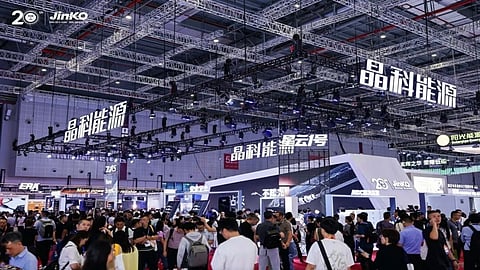


Leading PV manufacturer JinkoSolar announced that its independently developed n-type TOPCon-perovskite tandem solar cell has achieved a conversion efficiency of 34.82%, certified by the Shanghai Institute of Microsystem and Information Technology (SIMIT) of the Chinese Academy of Sciences.
The result surpasses the company’s previous record of 34.76% for the same technology route, achieved in November 2025 (see China Solar PV News Snippets).
JinkoSolar attributed the efficiency improvement to several innovations, including a dual-layer composite passivation-contact structure for n-type TOPCon cells, multidimensional interface passivation technology, gradient crystallization kinetics control, and enhanced optical coupling and light-management technologies.
Major energy developer CGN New Energy has released the shortlist for its 2026 centralized PV module procurement, covering 8.4 GW of planned purchases.
The tender was launched in April and comprises 2 packages, divided into 7 bidding lots of 1.2 GW each (see China Solar PV News Snippets).
The shortlisted suppliers are TCL TZE, JinkoSolar, JA, GCL SI, Gokin Solar, Yingli Solar, and Astronergy.
Quoted module prices range from RMB 0.742/W to RMB 0.770/W.
PV inverter and energy storage system manufacturer Growatt has submitted an updated listing application to the Main Board of the Hong Kong Stock Exchange.
The filing represents the company’s third attempt to complete a Hong Kong IPO after previous applications in 2022 and 2023 lapsed.
According to the prospectus, Growatt reported revenue of RMB 5.36 billion in 2023, RMB 4.48 billion in 2024, and RMB 5.23 billion in 2025. Net profit was RMB 843 million, RMB 20 million, and RMB 413 million, respectively.
Energy storage has become the company’s largest growth segment, with revenue from the business doubling year-over-year to RMB 3.32 billion in 2025, accounting for more than 60% of total revenue.
Growatt said IPO proceeds will be used for overseas channel expansion, next-generation energy storage R&D, overseas R&D centers, and manufacturing capacity expansion.
TÜV Rheinland has partnered with LONGi, AIKO, TCL TZE, and Gokin Solar to jointly release the Technical Specification for Fire Prevention Assessment of PV Modules.
The specification addresses internal module failure mechanisms that can lead to fire incidents, including hot spots, DC arcs, aging contact resistance, and bypass diode failures. According to TÜV Rheinland, existing standards such as UL 790 and IEC 61730 primarily focus on external fire exposure and flame spread. The new framework employs accelerated aging and stress testing to evaluate a module’s fire-prevention capability under realistic operating conditions.
TÜV Rheinland said the specification is the industry’s first systematic technical standard focused specifically on PV module fire-prevention performance.
China’s National Development and Reform Commission (NDRC) and National Energy Administration (NEA) have jointly issued new regulations on renewable energy consumption and absorption, effective August 1, 2026.
The regulations establish a dual assessment mechanism combining minimum renewable energy consumption requirements on the demand side with renewable energy absorption responsibility targets on the grid side.
The demand-side requirements cover both electricity and non-electricity renewable energy consumption across sectors, including industry, construction, transportation, data centers, polysilicon manufacturing, and lithium batteries.
A notable feature of the new framework is the inclusion of non-electricity renewable energy utilization, supporting the development of green hydrogen, green ammonia, green methanol, and sustainable aviation fuel.
The policy also introduces differentiated provincial renewable energy absorption targets and sets mid- and long-term objectives extending to 2030.
