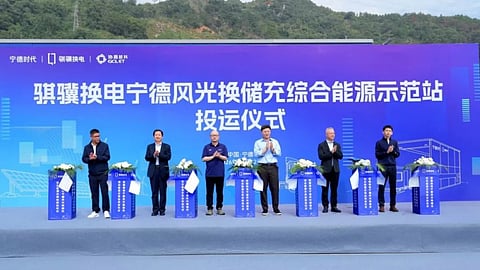


GCL Energy Technology Co., Ltd. (GCL-ET), the energy technology solutions arm of GCL Group, and QIJI Energy, CATL’s heavy-duty truck battery-swapping subsidiary, have commissioned an integrated renewable energy demonstration station in Ningde, Fujian province. The station combines a 94 kW wind-solar generation system with 930 kWh of energy storage and supports five-minute battery swapping and MW-scale supercharging. It is expected to consume 120 MWh of renewable electricity annually and cut carbon emissions by about 72 tonnes.
According to the companies, the project represents China’s first deployment of perovskite tandem PV technology in a heavy-duty truck charging and battery-swapping load scenario. Connected to GCL-ET’s virtual power plant (VPP) platform, it uses AI algorithms to dynamically coordinate PV generation, energy storage, and charging and battery-swapping loads for grid response and electricity market participation.
In July, GCL ET signed a framework agreement with the Shaoguan municipal government in Guangdong Province to develop a large-scale green computing hub (see China Solar PV News Snippets).
The China Electricity Council (CEC) reported that enterprises within its statistical scope commissioned 87 new electrochemical energy storage stations in Q3 2026, adding 12.6 GW/39.36 GWh of capacity. New installations rose 172% YoY and 3% QoQ, with Inner Mongolia, Xinjiang, Hebei, Shanxi, and Shandong ranking as the top five provinces and regions by additions.
By the end of the quarter, CEC’s statistics covered 2,363 operating electrochemical energy storage stations with a combined capacity of 143.53 GW/375.80 GWh.
In August, CEC forecast that solar power would surpass coal-fired power in installed capacity during the third quarter of 2026 (see China Solar PV News Snippets).
PV and lithium battery equipment manufacturer LEAD has delivered a full-line equipment solution to upgrade an existing TOPCon cell production line to back-contact (BC) technology for an undisclosed major PV customer. The solution uses an LPCVD + PE-Poly process compatible with existing TOPCon lines, enabling conversion into high-efficiency BC lines without constructing new factory buildings.
LEAD said the project reuses wet-process, high-temperature, film-deposition, screen-printing, and firing and automation equipment, requiring only additional laser and etching equipment. According to the company, this achieves a 75% equipment reuse rate and cuts capital expenditure by more than half compared with building a new BC line.
On the topic of TOPCon to BC line conversion, DAS Solar recently revealed that it plans to convert its 14 GW TOPCon cell production base in Xinzhou, Shanxi Province, to DBC technology (see China Solar PV News Snippets).
China’s Ministry of Commerce and General Administration of Customs have extended the suspension of export controls covering lithium batteries, specified battery materials, and related manufacturing equipment and technologies from November 11, 2026, through January 10, 2027.
The measures apply to rechargeable lithium-ion batteries with a gravimetric energy density of at least 300 Wh/kg, as well as specified LFP cathode materials, ternary cathode material precursors, lithium-rich manganese-based cathode materials, graphite anode materials, and related manufacturing equipment and technologies.
Announced in October 2025, the controls were originally scheduled to take effect on November 8, 2025, but were suspended prior to implementation and have never entered into force. The latest notice states that the suspension will run until January 10, 2027, without specifying arrangements beyond that date.
The Jiangxi provincial government has issued its 15th Five-Year Plan (2026-2030) for developing a new energy system. The province targets total power generation capacity of more than 110 GW by 2030, including over 55 GW of new energy capacity – with an aspirational target of 60 GW – making new energy the province’s largest source of installed power capacity.
The plan calls for adding more than 18 GW of wind, solar, and biomass capacity during 2026-2030 while maintaining a new energy utilization rate above 90%. By 2030, Jiangxi aims for new-type energy storage capacity to exceed 5 GW, pumped-storage capacity to reach 3.3 GW, VPPs to provide 3 GW of regulation capacity, and demand response capability to reach 2.9 GW, while raising generation- and storage-side regulation capability by more than 40%.