

China’s 15th Five-Year Plan targets to expand renewable energy to strengthen electricity supply while increasing the role of energy storage and grid flexibility
The roadmap includes large-scale wind, solar, offshore wind, hydropower, and distributed renewable projects alongside green hydrogen and biomass
The plan also encourages investment in advanced renewable technologies, including perovskite tandem and space-based solar
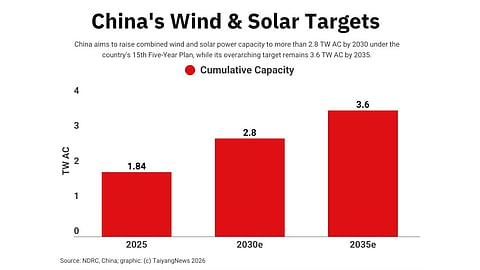
Renewable energy is at the center of China’s next phase of economic and energy transition under its 15th Five-Year Plan (FYP) covering the 2026-2030 period, with wind and solar expected to play the leading role. The roadmap targets more than 2.8 TW AC of combined wind and solar capacity by 2030, as part of a broader goal to reach around 3.5 TW AC of total renewable power capacity.
Together, wind and solar power will account for more than 50% of China's targeted 3.5 TW AC renewable energy capacity by 2030. They are also expected to generate over 4 trillion kWh of electricity annually, contributing the majority of the country's projected 6 trillion kWh of total renewable power generation.
This target envisions only 960 GW AC of new wind and solar capacity additions by the end of this decade since their combined share reached 1.84 TW AC at the end of 2025, translating into annual additions of around 192 GW AC. This is much lower than the country’s potential since in 2025 solar PV alone added over 315 GW AC while wind expanded by more than 119 GW AC (see China Sets New Annual Solar PV Installation Record In 2025).
Back then, the country had also reached halfway to its 3.6 TW AC solar and wind energy goal for 2035 (see China Announces 3.6 TW AC Solar & Wind Target For 2035).
Frank Haugwitz of Apricum points out that the government specifies a 2.8 TW AC target for wind and solar as binding, meaning it is the minimum capacity targeted. Beyond wind and solar, China will also target to achieve 300 GW of new energy storage capacity, as shared by the National Energy Administration (NEA) previously, up from 136 GW at the end of 2025, and 50 GW of vehicle-to-grid (V2G), growing from 19 GW at the end of last year, according to Haugwitz.
While battery energy storage is expected to account for the largest share of the 300 GW new storage capacity, China's definition of ‘new energy storage’ covers all non-pumped-hydro electricity storage technologies, including electrochemical batteries, compressed air energy storage (CAES), flywheels, supercapacitors, and other emerging technologies.
China also targets to add 370 GW of new large-scale solar and wind energy bases in northern areas during the 15th FYP.
Beyond electricity generation, the plan aims to increase the use of renewable energy in sectors such as heating, transport and industry. It also adopts a target of 2 million tons of green hydrogen production capacity by 2030.
The roadmap also emphasizes continued investment in advanced renewable technologies, including perovskite tandem solar cells and space-based solar power generation technologies, among others.
The complete plan is available in Chinese on the National Development Reform Commission’s (NDRC) website.
