

An ECA report finds that renewable energy deployment and energy independence goals in the EU under REPowerEU remain behind target
REPowerEU-funded measures are expected to add at least 20 GW of renewable capacity by 2026, less than 20% of the 103 GW target
The ECA recommends the EU to ensure stronger monitoring, clearer targets and greater visibility on how the plan’s financing gap will be addressed
The European Court of Auditors (ECA) says the European Union’s (EU) €300 billion REPowerEU plan is ‘faltering’ in its efforts to secure energy independence from Russia. While the bloc is making progress on its clean energy goals, implementation remains ‘too slow’, the auditors say in a new report.
“Four years after its launch, REPowerEU has stalled, even though several hundred billion euros have been made available,” said Mihails Kozlovs, the ECA Member in charge of the report.
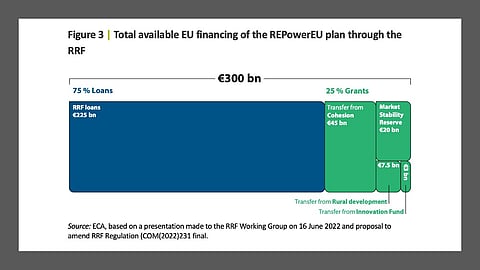
REPowerEU was adopted by the EU in May 2022 as its plan to stop buying Russian oil, gas and coal, accelerate transition to clean energy, diversify its global supply of gas and LNG, and strengthen cross-border energy connections. Achieving these objectives requires additional investments of about €300 billion by 2030, made available through the Recovery and Resilience Facility (RRF).
However, as of April 2026, the ECA says that of the €300 billion available, only €54.3 billion or 18% of the investment needed had been committed. The ECA believes this huge gap could either mean investment needs were wrongly estimated and ‘largely overblown’, or there is an inability to translate objectives into concrete action.
Most of the countries did not include specific actions or targets to move REPowerEU on the ground in their national energy and climate plans. The plan has, in fact, done little to accelerate the clean energy transition by increasing renewable production capacity, as per the report.
As an emergency plan, REPowerEU supports the Fit-for-55 target of raising the share of renewables in the EU’s gross final energy consumption to 42.5% and adding 103 GW of solar and wind capacity by 2030. Measures funded through REPowerEU are expected to add at least 20 GW of renewable capacity by 2026 – accounting for less than 20% of the 103 GW target (62 GW solar and 41 GW wind).
Moreover, the ECA highlights that the plan’s governance and monitoring tools are not strong enough to track progress effectively. For instance, only 12 of 45 REPowerEU-funded renewable energy measures have clear, measurable targets, totaling 1.6 GW (close to 1.6% of the 103 GW target), making their progress difficult to assess. Most of the investments are directed toward solar, while wind projects remain limited due to longer permitting and project lead times.
Without a major boost, the auditors believe the REPowerEU plan will be unable to reach its ambitious goal.
“We must learn the right lessons now, as the new geopolitical tensions and their impact on energy markets underscore the need to accelerate diversification and prevent future over-reliance on a single supplier. That is why we are calling for coordinated efforts to re-energise the plan,” explained Kozlovs.
The ECA recommends that the EU should strengthen REPowerEU’s monitoring and governance by setting clearer targets, timelines, investment needs, funding sources, and performance indicators. Future funding instruments must be linked to clear, results-oriented targets and be supported by realistic timelines.
It also calls for better, more timely information on the financing gap, with member states providing annual details on the budgets and funding sources for REPowerEU actions.
The ECA report, titled Implementation of the REPowerEU plan needs a boost, is available for free download on its website.
This report follows a similar study by SolarPower Europe that points to the slow rollout of the Net-Zero Industry Act (NZIA) among member states to expand solar PV capacity in the EU (see EU NZIA Could Unlock 31 GW Solar By 2030, But Rollout Slow).
