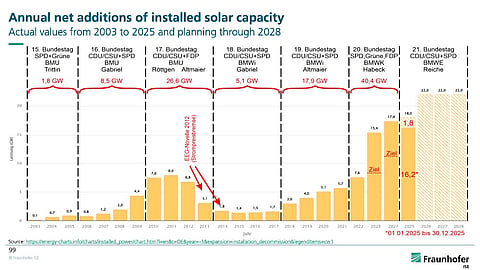


Germany added around 16.2 GW DC/14.3 GW AC of solar PV capacity in 2025, slightly below the 18 GW annual target, according to Fraunhofer ISE
Solar power generation increased by about 21% YoY to around 87 TWh in 2025, making PV the 2nd largest source of public net electricity generation
Renewables dominate the power mix, led by wind and solar, which together accounted for 55.9% of Germany’s power generation last year
Germany added around 16.2 GW DC/14.3 GW AC solar PV capacity in 2025, bringing the cumulative total to 116.8 GW DC/106.7 GW AC at the end of the year, according to the energy-charts.info data platform of Fraunhofer Institute for Solar Energy Systems ISE.
This will be almost at the same level as 16.73 GW pf annual additions that the Federal Network Agency (Bundesnetzagentur) announced in 2024, but still missing its annual target of 18 GW for 2025 (see Germany Officially Exceeds 100 GW Cumulative Solar PV Capacity).
While the official figures for 2025 are yet to be released by the agency, Fraunhofer ISE’s estimate is lower than SolarPower Europe’s 17.6 GW projection for last year (see EU Solar Growth Slows With First Annual Dip Since 2016).
According to German solar energy association BSW Solar, the country installed around 17.5 GW DC solar in 2025, comprising 8 GW of ground-mounted solar parks compared to 6.5 GW in 2024, but there was a decline in commercial and industrial systems with 3.7 GW (3.9 GW in 2024), as well as in residential PV segment with around 5.2 GW installed (6.8 GW in 2024). Plug-in solar devices contributed close to 500 MW, up from approximately 400 MW in 2024.
Fraunhofer ISE’s charts show that Germany’s solar energy production increased by approximately 15 TWh or 21% in 2025 from the previous year, as this technology took the 2nd place in its share of public net electricity generation. Annual generation from PV systems totaled around 87 TWh, of which approximately 71 TWh was fed into the public grid, and a ‘remarkable’ 16.9 TWh was consumed by the producers.
On June 20, 2025, solar energy fed about 50.4 GW into the grid between 12:45 and 13:00, its maximum. On June 21, 2025, solar energy reached its maximum share of the total daily load at 41.2%.
“The sharp rise in solar power generation in 2025 is an EU-wide trend. In EU countries, electricity generation from PV exceeded the combined total from lignite and hard coal (243 TWh) for the first time, reaching 275 TWh. In the past ten years, photovoltaic generation has tripled, while coal-fired power generation has fallen by 60 percent,” reads the Fraunhofer ISE analysis.
On the other hand, wind power turned out to be the strongest net electricity producer in Germany with 106 TWh of production, which was 3.2% lower on a year-on-year (YoY) basis.
Together, wind and solar energy led renewable energy, accounting for 55.9% of the national power generation last year. Battery storage continues its ‘dynamic development’ as interest grows in grid connections for large-scale systems. Over the course of the year, the capacity of large-scale battery storage systems rose from 2.3 GWh to 3.7 GWh, a 60% increase. The market currently has a little under 25 GWh battery storage capacity installed, with under 20 GWh being home storage systems, says Fraunhofer ISE.
BSW-Solar now recommends that the government remove further market barriers that could worsen the regulatory support framework for solar energy systems, referring to German Federal Minister for Economic Affairs and Energy Katherina Reiche’s proposal to end subsidies for rooftop solar (see Germany Mulling End To Subsidies For Small-Scale Solar Systems).
Fraunhofer ISE says the country needs to install 22 GW in 2026, which is what the government aims for Germany to reach its 2030 target of 215 GW cumulative capacity (see German Government Agrees On Higher 2030 Solar Goal of 215 GW).
