

Wood Mackenzie expects rising electricity demand from data centers, manufacturing, and transport electrification to drive demand for solar in 2026
Despite coal and gas dominating generation today in the US and Asia Pacific, solar will continue to lead new capacity additions
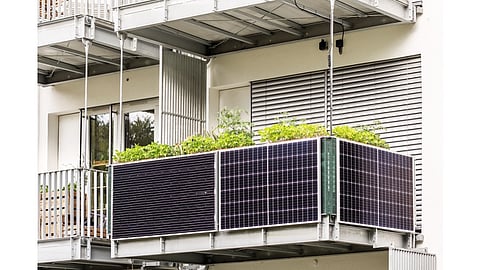
Balcony solar is likely to become an interesting customer-driven application, even beyond Europe
Mega projects like Abu Dhabi’s 5.2 GW solar PV plant with integrated battery storage signal a shift toward RTC baseload renewable energy projects
Global solar market fundamentals and demand are expected to remain strong in 2026, despite the disruptions seen in 2025, according to a new report by Wood Mackenzie, referring to the volatile environment for solar in the US and structural changes in China, the world’s largest market.
It expects the global cumulative installed solar PV capacity to nearly triple from almost 3 TW DC capacity at present to nearly 8 TW DC by 2034.
In its report titled Global solar: three things to look for in 2026, Wood Mackenzie highlights 3 major factors that the analysts believe will influence solar market performance and policy trends in 2026.
Electrification
Demand for electricity will continue to grow as electrification continues around the globe. Wood Mackenzie highlights the role data centers, manufacturing facilities, and transport electrification will play here, led by the US and Asia Pacific markets.
Gas currently remains the dominant source of electricity supply in the US, but solar generation will contribute as much to the new supply between 2026 and 2030. Analysts believe solar and other renewables will be critical for meeting new power demand in the near term.
In the Asia Pacific region, solar’s cost competitiveness ensures it leads new capacity investments, even though coal and gas continue to dominate the region’s power generation, as in the US. Solar’s share in Asia Pacific’s power generation mix is expected to grow from 11% in 2025 to 17% by 2030.
Balcony Solar
Already a hit in Germany and gaining popularity elsewhere in Europe, balcony solar or plug-in solar systems will catch the global markets’ fancy this year, as these are easy to install and operate at home. Wood Mackenzie argues that balcony solar is no longer a ‘niche’ and is now preferred with small batteries.
In the US, Utah has already brought in a policy framework to boost the adoption of systems that produce up to 1.2 kW of power without the need for utility interconnection or approvals. More than a dozen states now have similar legislation (see Solar & Storage Receive Boost In Illinois & California).
Yet, the growth of balcony solar in the US remains uncertain, as this market – despite its potential – lags behind in uniform electrical standards, lower household voltage limits, and fewer apartments with balconies. Nevertheless, analysts still see balcony solar enabling more policy and market attention this year.
Baseload Power
The Masdar-led 5.2 GW solar PV project integrated with 19 GWh of battery storage in Abu Dhabi is the world’s largest combined project for these technologies. It will generate 1 GW of continuous and uninterrupted renewable energy (see UAE To Host World’s ‘1st’ Facility To Provide RE 24x7, At Scale).
Wood Mackenzie says this project represents a ‘structural shift in hybrid project development’ because it does not use battery storage as an ancillary but integrates it into the design since inception to provide firm round-the-clock (RTC) renewable energy. It directly targets offtakers with inflexible load profiles such as data centers and artificial intelligence hubs.
It may be an expensive model to replicate everywhere, but it could redefine how baseload power is supplied. Its success, however, will depend on whether offtakers are willing to pay a premium for reliable, low-carbon power, since the Abu Dhabi project is currently more expensive than gas-fired alternatives.
“As new gas plants continue to rise in cost and supply chain constraints push out wait times for gas turbines, these sorts of hybrid projects might be one of the most viable options for new loads,” says Wood Mackenzie’s Head of Global Solar, Michelle Davis.
Masdar recently announced a similar project in Uzbekistan for 1 GW of baseload power, with a GW-scale RTC clean energy project (see Uzbekistan To Explore Round-The-Clock GW-Scale Clean Energy Project).
