

India’s solar module manufacturing capacity has grown much faster than cell and upstream capacity, raising the risk of oversupply, according to a new report
New demand from data centers, green hydrogen, and exports could ease some of the pressure
The capacity mismatch could increase pressure on smaller manufacturers and accelerate consolidation across the sector
India’s solar manufacturing sector is heading toward a potential oversupply of module capacity, cautions a new report by the Institute for Energy Economics and Financial Analysis (IEEFA) and JMK Research. India’s cumulative nameplate solar module manufacturing capacity reached 233 GW as of June 2026, with another 135 GW in the pipeline.
This capacity is well ahead of India’s annual demand since the country installed around 13 GW in FY2022, reaching over 30 GW in FY2025. Over the same period, its module production capacity rose from around 38 GW to over 90 GW.
While India's nameplate module production capacity has made it one of the largest module manufacturing bases globally, this growth is woefully short on vertical integration. As per the analysis, the 233 GW is nearly 7 times India’s solar cell manufacturing capacity, and 116 times higher than ingot and wafer capacity.
With this arrangement, India’s solar supply chain remains dependent on imports, mainly from China.
Report writers attribute the rapid build-out of module capacity partly to the relatively low barriers to module assembly since such projects require less capital and can be commissioned faster than cell or ingot-wafer facilities. Cell and ingot-wafer manufacturing, by comparison, require substantially higher investment, longer construction periods and more specialized expertise.
The difference has resulted in a manufacturing base that has grown much faster downstream than upstream.
Analysts also highlight that manufacturers are already operating below sustainable utilization levels – 35% to 40% –as compared to 50% to 65% needed to operate sustainably. Upcoming capacity additions could put further pressure on the market.
According to the report titled Assessing overcapacity risk in India’s solar PV manufacturing market, this imbalance could become more pronounced as additional projects come online. The report says about 135 GW of future module capacity is backed by firm investment commitments and near-certain commissioning schedules. This raises the risk of further widening the gap between available supply and market demand.
Analysts believe that continued capacity additions could put further pressure on factory utilization, margins and investment returns. Standalone manufacturers could face a higher risk of stranded assets if demand does not grow quickly enough, they warn.
The capacity imbalance could also change the structure of India's solar manufacturing industry as consolidation concerns become real. Smaller, non-integrated manufacturers may face greater pressure as surplus capacity increases, while companies with vertically integrated operations, greater scale, and stronger technology capabilities could be better positioned.
According to the analysts, the sequencing of India's Approved List of Models and Manufacturers (ALMM) framework has contributed to the imbalance in India’s vertical integration. ALMM List-I for modules became operational in March 2021, and nearly five years later ALMM List II for cells became operational in June 2026 (see India Brings ALMM List-II For Solar Cells Into Force).
The government now plans to bring ALMM List-III for wafers into force from June 1, 2028 (see India To Enforce ALMM List-III For Ingots, Wafers On June 1, 2028).
“This staggered rollout created a one-sided demand pull for modules, while cells continued to compete against lower-cost imports, directing investment toward the only segment with assured offtake,” reads the report.
Simultaneously, the report highlights that domestic demand has faced near-term constraints, especially due to contraction in utility-scale tenders. For instance, renewable energy tenders issued in FY2026 totaled about 24 GW, down around 47% from nearly 45 GW in FY2025, even though the annual bidding target is 50 GW. The report links the decline to issues including land acquisition, grid connectivity and delays in power supply agreement execution.
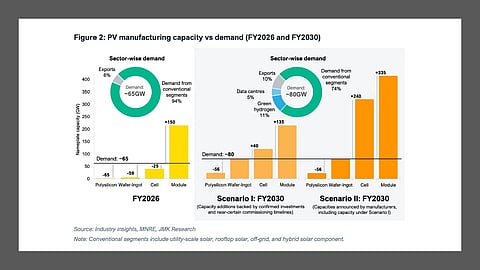
The report’s scenarios show that the mismatch across India’s PV manufacturing chain could persist through FY2030. In FY2026, domestic demand was about 65 GW, but module production capacity had reached 150 GW, while cell, wafer-ingot, and polysilicon capacity remained below demand.
Based on confirmed investments and credible commissioning timelines, India’s annual solar demand is expected to reach about 80 GW by FY2030 under Scenario I modeled in the report. Yet module capacity would still have a 135 GW surplus, while cell capacity would move into a 40 GW surplus. Wafer-ingot capacity would nearly meet demand, but polysilicon would remain 56 GW short.
The oversupply risk under Scenario II, which includes all announced capacity and Scenario I capacity, is much larger. Module capacity would exceed around 80 GW of expected demand by 335 GW, while cell capacity would have a 240 GW surplus. Polysilicon would continue to show a 56 GW shortfall.
“These scenarios point to sustained utilisation pressure across the PV manufacturing value chain, particularly in modules, where Tier I manufacturers already operated at 50–85% utilisation in FY2026. As surplus capacity expands, the sector is likely to face increasing margin pressure and a higher risk of stranded manufacturing assets,” according to the analysts.
The report identifies data centers, green hydrogen and exports as the main potential sources of additional module demand through 2030, while India’s domestic demand accelerates. Together, these areas could create an estimated 17 GW to 22 GW of annual incremental solar demand beyond conventional deployment, provided policy support and project execution keep pace.
Data centers, with their preference for open access and captive procurement requirements, alone could provide around 2 GW to 3 GW of annual solar demand by 2030, according to the report.
Analysts see exports as playing a larger role in utilizing India's manufacturing base while domestic demand accelerates. India's previous reliance on the US as a major export market, disrupted by high tariffs, has highlighted the risks of depending heavily on one destination.
They identify Europe as a more structured medium-term opportunity for Indian manufacturers as its policies increasingly emphasize supply-chain resilience and diversification.
“The timing favours such investment, as leading Chinese producers are absorbing losses from oversupply while Indian manufacturers have stayed profitable,” highlights the report.
But, as the analysts point out, gaining access to new markets alone may not be enough. Indian manufacturers would need to narrow the cost and technology gap with Chinese producers through greater scale, vertical integration and operational efficiency.
Indian solar modules remain more expensive than Chinese modules, but the cost gap has narrowed. Indian module costs fell from $0.18/W in 2024 to $0.15/W in March 2026, a 28.6% reduction, while Chinese module costs declined from $0.11/W to $0.10/W over the same period.
The complete report is available for free download on IEEFA’s website.
TaiyangNews will delve into India’s solar PV manufacturing industry during the two-day Solar Technology Conference India (STC.I 2027) on January 20-21, 2027, in New Delhi. The third edition of the annual in-person conference will cover the entire upstream supply chain. Registrations will open soon.
