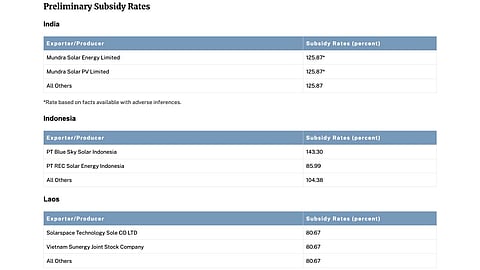


The US has issued preliminary subsidy rates on solar imports from India, Indonesia, and Laos, with rates reaching over 143%
For India, subsidy rates have been determined as 125.87%, for Laos 80.67%; Indonesia faces a general rate of 104.38%
The Department of Commerce is expected to announce preliminary antidumping duties on April 21, 2026
The investigation was launched in August 2025 following a petition by the Alliance for American Solar Manufacturing and Trade, which has now welcomed the preliminary determinations
The US Department of Commerce (DOC) has released preliminary determinations in its countervailing duties (CVD) investigation into solar imports from India, Indonesia, and Laos, with rates as high as over 143%. A final determination in this investigation is scheduled to be issued on July 6, 2026.
For India, the subsidy rates have been determined as 125.87% for Mundra Solar Energy Limited and Mundra Solar PV Limited – both Adani Group companies – as well as for all others.
An individual rate of 143.30% has been determined for PT Blue Sky Solar Indonesia, 85.99% for PT REC Solar Energy Indonesia, and a general rate of 104.38% will apply to all others from Indonesia.
Solarspace Technology Sole CO. LTD., Vietnam Sunergy Joint Stock Company, and all others from Laos have to pay a preliminary CVD rate of 80.67% for imports to the US.
CVD is imposed to offset any subsidies provided by exporters’ governments. With the tariffs, prices for subsidized imports are brought to fair value in global markets. Solar imports from the Southeast Asian nations of Cambodia, Thailand, and Malaysia have already been subject to heavy AD/CVD (see US Solar Imports From Cambodia Hit Hardest With Final AD/CVD Duties).
The department is expected to release the preliminary determination of antidumping duties (AD) on April 21, 2026. Once the International Trade Commission (ITC) issues the final injury determination for both AD and CVD investigations on October 19, 2026, orders will be issued on October 26, 2026.
The DOC launched trade investigations for antidumping and countervailing duties (AD/CVD) on solar imports from the 3 above-mentioned Asian nations in August 2025 at the request of domestic solar manufacturers part of Alliance for American Solar Manufacturing and Trade (AASMT) (see US Investigates Solar Trade From Laos, Indonesia & India).
Investigations into crystalline silicon solar cell and module imports from India, Indonesia, and Laos were initiated after AASMT accused companies of shifting their operations from Cambodia, Malaysia, Thailand, and Vietnam to avoid paying the AD/CVD duties imposed (see US Solar Makers Seek AD/CVD Tariffs On India, Laos, Indonesia).
AASMT has welcomed the DOC’s preliminary determination on CVD tariffs. The alliance argues that unfair trade has caused solar imports from Indonesia to increase by more than 500% in 2025, to $2.5 billion of cells and modules. From Laos, too, the imports totaled $1.5 billion, having gone up by more than 500% last year.
“The preliminary determinations mean that preliminary duties will be imposed, and cash deposits collected, to offset the amount of the government subsidies provided to producers in these three countries,” stated AASMT.“These duties will be collected immediately after Commerce issues an order to U.S. Customs and Border Protection.”
Co-Chair of Wiley Rein’s International Trade Practice and Lead Attorney for AASMT, Tim Bright said, “Today’s finding is an important step toward restoring fair competition in the U.S. solar market.” He added, “American manufacturers are investing billions of dollars to rebuild domestic capacity and create good-paying jobs. Those investments cannot succeed if unfairly traded imports are allowed to distort the market.”
Recently, the DOC said the existing AD/CVD on solar imports from China and Taiwan will continue (see US Continues AD/CVD Duties On China, Taiwan Solar Imports).
The fresh duties on India, Indonesia, and Laos are expected to make solar modules from these countries more expensive in the short term, potentially raising procurement costs and, in turn, large-scale project costs in the US.
The move could benefit US manufacturers by improving their price competitiveness and supporting domestic demand. Meanwhile, exporters from the affected countries are likely to diversify shipments to markets such as Africa, Europe and the Middle East, where they will compete more directly with Chinese suppliers.
