

MNRE is contemplating a support scheme for agrivoltaics either under PM-KUSUM or separately
The ministry expects India could add around 5 GW of agrivoltaic capacity over the next three to four years
Financial and policy support could make solar deployment more widespread in the country via agrivoltaics
India is considering a financial support scheme to encourage agrivoltaics to encourage dual use of land for solar power generation and farming. The Ministry of New and Renewable Energy (MNRE) sees the potential to add around 5 GW of agrivoltaic capacity over the next three to four years.
MNRE Secretary Santosh Kumar Sarangi recently said that the government was working on a scheme to address the higher costs of agrivoltaic projects and incentivize stated to encourage their adoption. India’s technical agrivoltaics potential currently stands at between 1 TW to 2 TW (see TERI: India’s Agrivoltaic Potential May Reach 2.1 TW).
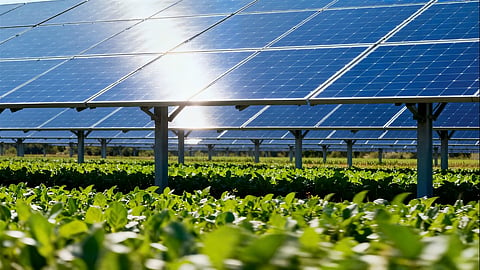
Under agrivoltaics, solar panels are installed on elevated structures, allowing crops to grow and farming activities to continue beneath them. The approach could help India expand solar power generation while reducing competition between renewable energy projects and agricultural land. Sarangi stressed that this approach could expand solar deployment beyond the top 5 states that currently account for 85% of deployment, to even those with less non-agricultural land.
Sarangi believes that agrivoltaic projects cost around 25% to 30% more than conventional ground-mounted solar installations because of the additional infrastructure needed to elevate the panels. The proposed scheme aims to address this cost difference and make projects more commercially viable.
The projected addition of 5 GW would nevertheless depend partly on state governments introducing suitable feed-in tariffs (FIT), which determine the price paid for electricity generated by these projects.
As per the ministry’s estimates, the cost of power from agrivoltaics plants could range between INR 3.20 to INR 3.30 per kWh, compared with INR 2.80 to INR 3 per kWh for decentralized solar installations under PM-KUSUM.
The ministry is considering whether to include the support under the existing PM-KUSUM scheme or introduce a separate program. It is working with the Ministry of Finance to determine its structure. It is also working on a policy document to guide the development of agrivoltaics and engaging with electricity distribution companies to facilitate power purchases, according to the MNRE Secretary.
Speaking with the media ahead of the Agrivoltaics World Conference 2026 to be held in New Delhi, Sarangi shared that trials conducted with the Indian Agricultural Research Institute (IARI) have helped identify crops suited to agrivoltaic installations across different agro-climatic zones.
While fruits and leafy vegetables had shown encouraging results, the arrangement doesn’t seem to work as well for rice and sugarcane. He identified Madhya Pradesh, Odisha, Chhattisgarh, West Bengal and Uttar Pradesh as states with potential for deployment.
Earlier this year, India approved a new floating PV scheme to target 5 GW capacity, combined with 2-hour energy storage systems (see India Launches 5 GW Floating Solar Scheme With Storage).
