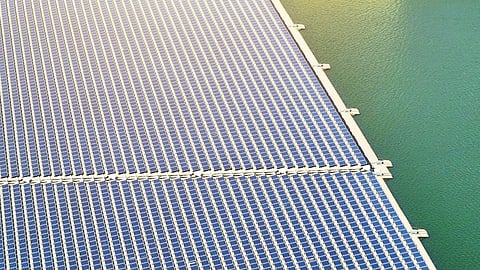


India’s Union Cabinet has approved a new floating solar PV scheme, accompanied by energy storage systems
The scheme aims to scale India's floating solar capacity from around 700 MW to 5 GW while integrating a minimum 2-hour energy storage requirement
Aligned with India's broader renewable energy expansion strategy, it taps into only a fraction of the country's estimated 102 GW floating solar potential
India has rolled out a new INR 5,070 crore scheme to deploy 5 GW of floating solar PV with energy storage systems (ESS) under the Pradhan Mantri Surya Sarovar Yojana (PM-SSY).
It will expand India’s floating solar PV capacity from around 700 MW at present to 5 GW, the Ministry of New and Renewable Energy (MNRE) stated. Approved by the Union Cabinet, the scheme targets a minimum storage capacity of 2 hours, amounting to a total storage capacity of 10,000 MWh.
This capacity will be spread across existing reservoirs and industrial ponds in states and union territories. According to the ministry, this will save land resources and promote domestic manufacturing of flotation systems, along with the entire value chain, such as cells, modules, ESS, among others. It will also improve grid reliability through integrated energy storage.
The ministry estimates the scheme to generate 16,000 to 17,000 full-time equivalent jobs.
Projects will be sanctioned during FY 2026-27 to FY 2030-31, selected based on tariff-based competitive bidding. Financial support will be disbursed until FY 2032-22.
Under the scheme, eligible projects will receive central financial assistance (CFA) of INR 1 crore/MW on successful commissioning. An additional amount of up to INR 50 lakh/project will be available to conduct feasibility studies, including bathymetry and hydrography assessments, environment studies, among other activities to de-risk the project development, it added.
While the scheme envisages the deployment of 5 GW floating solar PV capacity, the National Institute of Solar Energy (NISE) estimates close to 102.18 GW potential for India’s reservoirs and other suitable inland water bodies (see India: 102 GW Floating Solar Potential, Policy In Works).
Nevertheless, the industry is happy with the new initiative. Subrahmanyam Pulipaka, CEO of National Solar Energy Federation of India (NSEFI) that advocated for the policy, said, “Heartening to see the Floating Solar Segment of Indian Solar Industry get its due recognition through Pradhan Mantri Surya Sarovar Yojana. This catapults India to few selected Nations which didn't leave any stone unturned to tap the potential of Solar.”
Solar PV is central to the government’s overarching target of 500 GW non-fossil-fuel power generation capacity by 2030, as it is estimated to provide 280 GW to 300 GW to the total.
As of June 30, 2026, the country’s total installed solar power capacity reached 162.15 GW, a 50× expansion from 3 GW in 2014. Within 2025, its annual additions totaled 37 GW, surpassing the US as the world’s second-largest solar market. The total at the end of June 2026 comprised 118.79 GW of large-scale and 27.88 GW of rooftop solar systems. The latter is flourishing in India of late, for which the government credits its PM Surya Ghar: Muft Bijli Yojana (PMSGMBY).
PM-SSY, says the ministry, is the government’s ‘latest push for solar growth’.
