

Energy storage and integrated solutions emerged as recurring themes across the exhibition, reflecting the industry's changing priorities
Manufacturers focused on improving existing technologies, while BC modules emerged as the next big trend; HJT had a much lower profile
Manufacturers focused on improving existing solar technologies and expanding products for different applications rather than introducing disruptive innovations
Chinese manufacturers dominated across solar and storage, while Indian companies showcased their growing manufacturing capabilities and export ambitions
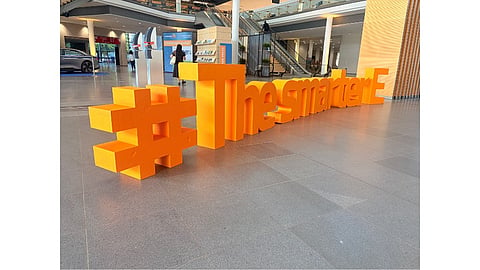
The intensity of activity at Intersolar Europe 2026 – part of the annual The smarter E trade show – was so high that it matched the soaring temperatures outside Messe München. As thousands of visitors thronged the event over 3 days, one message stood out clearly: energy storage is just as important as solar.
Doing the rounds of the trade show floor, Team TaiyangNews found that battery energy storage systems (BESS) dominated the exhibition, with almost every major company showcasing solutions for utility-scale and commercial and industrial (C&I) applications. In the residential space, plug-and-play and focused products highlighted the booths.
Integrated Solutions Become the Norm
The exhibition also reflected a broader industry shift. Companies are no longer positioning themselves as module, inverter, or battery suppliers alone. Instead, they are offering complete energy solutions that combine solar modules, battery storage, inverters, energy management systems (EMS), EV charging, and software on a single platform.
The message was clear: customers are increasingly looking for integrated solutions rather than individual products, while companies are diversifying their portfolios rather than sticking only to solar in these times of tough competition.
China-based manufacturers continued to dominate the exhibition floor with some of the largest booths and the widest product portfolios. Beyond solar modules, they showcased batteries, inverters, smart energy management platforms, and complete integrated solutions, reinforcing China's leadership across the clean energy supply chain.
BC Gains Ground as TOPCon Stays Strong
On the solar side, the focus was less on breakthrough technologies and more on improving products already in commercial production. TOPCon remained the dominant cell technology, with manufacturers introducing upgraded modules offering higher efficiencies, better bifaciality, and improved overall performance through edge passivation and multi-cut cell designs, among others.
Companies including JinkoSolar, JA, Trinasolar and Astronergy displayed their latest TOPCon products, showing there is still room to improve the technology.
At the same time, back contact (BC) technology gained significant momentum. Companies such as AIKO and LONGi showcased high-efficiency BC modules designed to deliver higher energy output and improved performance. While TOPCon continues to lead global shipments, BC is increasingly emerging as the premium technology for applications where maximum efficiency is a priority.
In contrast, there were relatively fewer heterojunction (HJT) product launches compared with TOPCon and BC at this year's event.
Beyond modules and storage, exhibitors also highlighted emerging applications such as floating solar and agrivoltaics for reservoirs, farmland and other space-constrained locations.
The smarter E AWARD winners further underscored the direction the industry is taking. The recognized technologies and projects highlighted advances in solar PV, battery storage, virtual power plants (VPPs), green hydrogen, and smart energy management.
As the focus country at this year's Intersolar Europe, India had a visible presence on the exhibition floor. Manufacturers including Waaree, Premier Energies, Vikram Solar, Saatvik Green Energy, and Goldi Solar were among the exhibitors. Many said Europe remains an important market as they look to expand exports and strengthen manufacturing and technology partnerships.
Despite the optimism on the show floor, several exhibitors acknowledged that the industry's financial challenges are far from over. A representative from a Tier II solar PV manufacturer said companies may have to ‘wait, watch and sit tight’ over the next 12 to 18 months, with a meaningful recovery expected only expected in the latter half of 2027 or into 2028. While Tier I manufacturers are expected to weather the downturn better, he added, many Tier II and Tier III players could continue to face intense pricing pressure and consolidation.
To summarize, if there was one defining takeaway from Intersolar Europe 2026, it was that the industry is moving beyond standalone solar products. Storage has become central to future projects, integrated energy solutions are replacing individual hardware offerings, and solar technology continues to evolve through higher efficiencies and better performance. Together, these trends signal the next phase of growth for the global clean energy industry.
TaiyangNews covered Intersolar Europe 2026 with real-time updates in a live blog, straight from the trade show.
TaiyangNews will be conducting a recap of the latest products at SNEC and Intersolar Europe 2026 in a 2-day Global PV System Technology Trends H1/2026 Conference on July 8 and 15. Registrations for this virtual event are free and can be done here.
