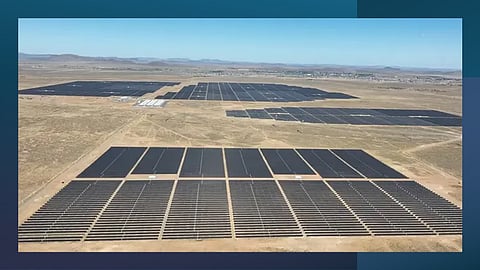


TotalEnergies, together with Hydra Storage Holding and Reatile Renewables, has inaugurated the Hydra project in South Africa’s Northern Cape, describing it as Africa’s largest hybrid renewable energy project. The facility combines a 216 MW solar PV plant with a 500 MWh battery energy storage system (BESS). It was awarded under South Africa’s Risk Mitigation Independent Power Producer Procurement Programme (RMIPPPP). The project will supply 75 MW of dispatchable renewable electricity to the national grid between 5:00 a.m. and 9:30 p.m. under a 20-year power purchase agreement (PPA) with Eskom. It is expected to generate more than 400 GWh of electricity annually. The Hydra project is jointly owned by TotalEnergies (35%), Hydra Storage Holding (35%), and Reatile Renewables (30%).
Zambian President Hakainde Hichilema recently inaugurated the 100 MW Chisamba Phase II Solar Power Plant, doubling the capacity of the Chisamba Solar Complex to 200 MW. The $70 million project was completed in about 7 months and created more than 1,400 local jobs, according to the Ministry of Energy. The president said the project supports Zambia's efforts to diversify its energy mix following the 2024 drought that impacted the country’s hydropower output. He reiterated the government's target of adding 1 GW of solar capacity by the end of 2026 as part of its goal to expand total installed power generation to 10 GW by 2030.
The government also signed contracts with five contractor groups to develop 156 solar power plants, each with a capacity of 2 MW, under the Presidential Constituency Energy Initiative (PCEI). The ZMW 4.3 billion program will add a combined 312 MW of solar capacity to the national grid and is expected to create around 15,600 jobs. Approved in November 2025, the initiative aims to strengthen Zambia's electricity supply through decentralized generation, with ZESCO overseeing project implementation and grid integration. The projects are scheduled for completion within 12 months.
The African Development Bank (AfDB) has approved up to $66 million for Phase I of the 500 MW Dandara Solar Project in Egypt, which includes a 100 MWh BESS. Located in Qena Governorate, the project is being developed by Norway’s Scatec. It will supply renewable electricity to the Aluminium Company of Egypt (EgyptAlum) under a 25-year PPA under a wheeling agreement with the Egyptian Electricity Transmission Company (EETC).
The financing package comprises $46 million from AfDB's ordinary resources and $20 million from the Climate Investment Funds' Clean Technology Fund (CTF). Additional funding is expected from other development finance institutions. Total project cost is estimated to exceed $290 million. Phase I of the project is scheduled to begin operations in early 2028 and is expected to generate about 1,373 GWh of electricity annually.
Chinese solar manufacturer Trinasolar has signed a memorandum of understanding (MoU) with Yemen-based Al-Raebi for Trading and Solar Energy Systems Company. Under the agreement, the duo will explore a potential 1.5 GW pipeline of large-scale solar projects in Yemen between 2026 and 2029. The companies will assess project opportunities, technical requirements, and cooperation models, with the potential deployment of Trinasolar's TOPCon 3.0 PV modules. The agreement also covers opportunities across the wider Middle East and aims to support the expansion of reliable, affordable solar power in the region.
Hong Kong-listed Shanxi Installation Group has secured an EPC contract worth approximately RMB 1.5 billion for the 500 MW Al Kamil Phase I solar PV project in Oman. The company says this project marks its first major project in the Middle East. It also covers 2.5 years of operation and maintenance. Developed by EDF Group subsidiary EDF power solutions, the project is located in Al Kamil Wal Wafi, around 230 km from Muscat. Shanxi said the contract strengthens its presence in the Middle East and expands its international renewable energy portfolio.
South African coal miner Exxaro Resources, through its renewable energy business Cennergi, has commissioned the 68 MW AC Lephalale Solar Project (LSP), its first utility-scale self-generation renewable energy asset in South Africa. Located near the company's Grootegeluk Mine in Limpopo, the behind-the-meter (BTM) solar PV plant comprises 129,024 modules installed across 185 hectares and is backed by a 25-year PPA with the mine. The ZAR 1.7 billion project is expected to generate around 176 GWh of renewable electricity annually to supply the mine. This will reduce its reliance on grid power during daylight hours. The facility has also been licensed for future BESS integration.
