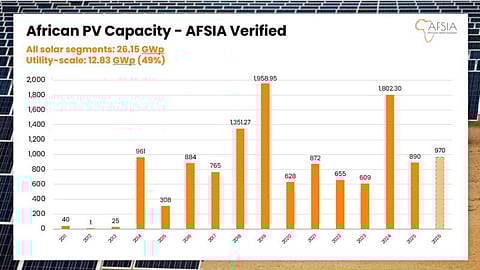


In Q1 2026, Africa installed close to 970 MW of utility-scale solar PV capacity, a record quarter for this segment on the continent, bringing the total installed solar capacity across all segments to 26.15 GW during the period. In comparison, the entire continent of Africa installed a little over 890 MW of utility-scale solar PV in 2025. Most of the Q1 2026 capacity came online in South Africa and Egypt, according to the Africa Solar Industry Association (AFSIA). Other notable mentions are Morocco, Nigeria, Zambia, and Namibia. According to AFSIA’s Director of Operations, Benjamin Clarke, the continent has close to 133 GW of utility-scale solar PV projects currently under development. However, several of these facilities are currently at early-stage development with ‘no clear path to financial close’.
Clarke stressed that this huge pipeline shows that the market is maturing now. “The question now isn't whether African solar can scale. It's which markets have the grid, the policy stability, and the financing structures to absorb what's coming,” stressed Clarke in a LinkedIn post. In its Africa Solar Outlook 2026, AFSIA identified 23.4 GW of operational solar projects across Africa at the end of 2025 (see AFSIA: Africa’s Solar PV Capacity Far Higher Than Estimates).
Oman-based Naqaa Sustainable Energy, an O-Green subsidiary, will build a 500 MW solar PV project in Botswana under a cooperation agreement signed between the governments. A subsidiary of the Oman Investment Authority, O-Green signed a power purchase agreement (PPA) with the Botswana Power Corporation (BPC) for the 500 MW project through its subsidiary, Naqaa Sustainable Energy. To be located in the city of Maun in Botswana, it will be integrated with a battery energy storage system (BESS) of up to 500 MW. Botswana calls it one of the largest renewable energy investments in the country as it seeks to secure 50% of its electricity needs from sustainable sources by 2030. This project is the 1st initiative to enter final commercial implementation as part of the 3 GW expanded energy cooperation framework between the 2 nations, signed in November 2025.
Mustafa Mohammed Al Hinai, CEO of O-Green, said the project supports Botswana’s goal of building a reliable clean energy system and strengthening its role as a regional energy hub. He noted it could double the country’s current generation capacity, while battery storage will improve grid reliability and help manage peak demand with round-the-clock renewable power.
The Africa Finance Corporation (AFC) has achieved financial close on Côte d’Ivoire’s 1st project finance green bond, supporting the development of a 66 MW solar power plant in the Korhogo region. Structured as a €65 million dual-currency facility, the bond marks a milestone for both the country and the wider West African monetary union, stated the AFC. It acted as lead underwriter and co-arranger, disbursing €43 million to the project, which is being developed by Poro Power. The plant is expected to become Côte d’Ivoire’s largest solar facility once operational in 2027. The project is designed to supply electricity to over 100,000 households and avoid more than 72,000 tonnes of CO₂ emissions annually. AFC says it also demonstrates a shift toward locally mobilized capital, with African institutions leading the financing structure and creating a model for future infrastructure investments across the continent.
France’s Voltalia has announced the full commissioning of the 148 MW Bolobedu solar power plant in Limpopo, South Africa. The project is among the country’s largest dedicated to supplying power to a single corporate client via a wheeling agreement through Eskom’s transmission network. The plant operates under a long-term corporate power purchase agreement (CPPA) with Richards Bay Minerals (RBM), a subsidiary of Rio Tinto. It is expected to generate around 300 GWh of electricity annually, reducing CO₂ emissions by more than 237,000 tonnes each year. The commissioning supports South Africa’s broader efforts to expand renewable energy capacity, improve energy security, and reduce reliance on coal, said the French renewable energy firm.
Nigerian renewable energy and power infrastructure firm Royal Power & Energy Limited (RPE) has been selected as a successful bidder under the World Bank-supported Utility Enabled Projects (UEP) program. Led by Nigeria’s Rural Electrification Agency (REA), the initiative aims to expand electricity access through renewable energy while strengthening public-private collaboration in addressing the country’s power deficit. RPE will deploy interconnected mini-grid systems integrated with existing distribution networks to deliver reliable and sustainable electricity to underserved communities and businesses.
Through this program, the World Bank is supporting Nigeria’s broader strategy to increase renewable energy adoption, ensure reliable power, and reduce reliance on fossil-fuel-based self-generation.
Senegal’s national utility Société nationale d'électricité du Sénégal (Senelec) has launched 2 new projects that combine solar power with battery storage as part of efforts to strengthen grid stability and expand renewable energy capacity. One of the projects involves a BESS integrated with the existing Diass Solar Plant. It will comprise 30 battery containers and 360 converters with an annual storage capacity of over 20,000 MWh. The system is expected to enhance electricity reliability and optimize solar output. It is financed by Germany’s KfW and France’s AFD.
The other project, located in Linguère, pairs a 50 MW solar plant with a 30 MW/90 MWh storage system and is expected to supply electricity to around 90,000 households. Huawei and Genertec CNTIC have partnered for this project. Both initiatives are part of Senegal’s broader strategy to increase the share of renewables in its energy mix and improve access to electricity, while addressing intermittency through integrated storage solutions, stated Senelec.
In the Central African Republic (CAR), Aptech Africa has installed solar PV systems at 3 healthcare facilities to improve reliability. The hybrid installations at Bégoua Health Center, Bédé Combattant Health Center, and Boye Rabe Hospital provide a combined capacity of around 102 kW, supported by battery storage to ensure continuous day-and-night power. Bégoua and Bédé Combattant each received 38 kW systems (19×550 W panels) with 30 kWh battery backup (BYD 15 kWh lithium battery), enabling uninterrupted operation of lighting, medical equipment, and vaccine refrigeration.
Boye Rabe Hospital in Bangui was equipped with a 26 kW system, including 20 kWh battery storage capacity of Pylontech modules and a Victron inverter, and remote monitoring for performance optimization. The installations reduce reliance on diesel generators and improve healthcare delivery by supporting cold-chain storage, diagnostic services, and night-time care, says Aptech.
