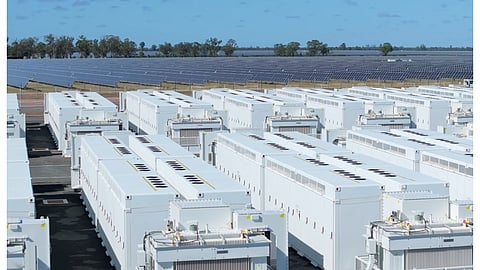


The Syrian Electricity Company (SEC) has signed three agreements with Saudi Arabia's Al-Harfi Construction to develop solar power projects with a combined generation capacity of 760 MW. These projects in the Widyan ar-Rabi’ area of Damascus Countryside will be backed by battery energy storage systems (BESS) totaling 1,077 MW, according to the Syrian Arab News Agency (SANA). The agreements follow a memorandum of understanding (MoU) signed in February 2026 between the General Establishment for Electricity Transmission and Distribution (PETDE) and Al-Harfi Construction for a 210 MW solar project supported by an 827 MWh BESS facility (see Middle East & Africa Solar PV News Snippets).
Mainstream Renewable Power has announced the commercial operation of its 50 MW Ilikwa Solar PV Plant in South Africa's Free State province. The facility will supply renewable electricity to multiple commercial and industrial (C&I) customers under Renewable Energy Supply Agreements (RESAs). Under the arrangement, it will offer shorter-term, more flexible power contracts. The project is jointly owned by Mainstream Renewable Power (70%) and Investec (30%) and is expected to generate around 141 GWh of electricity annually.
Independent power producer (IPP) SolarAfrica has announced a partnership with MPower, the energy platform of the Moolman Group, and Fledge Capital for a hybrid power project in South Africa. The trio has joined hands to develop the Highveld Hybrid Energy project in Mpumalanga, which will combine an 184 MW utility-scale solar PV plant with a 300 MWh battery energy storage system (BESS) near eMalahleni. Expected to begin supplying wheeled renewable electricity from 2029, the project aims to provide businesses with greater energy security, long-term price certainty and increased access to clean electricity, according to the partners.
Hungary-based climate infrastructure company EnerSynk Group is advancing a planned 500 MW solar project in Zambia, having secured regulatory and legal approvals for its contractual framework. The approvals from the Energy Regulation Board and the Office of the Attorney General for the utility-scale solar project will enable the company to carry out feasibility studies. It will also move ahead with grid and environmental assessments, financing and implementation. Once operational, the project is expected to strengthen Zambia’s electricity supply and generate an estimated $2.8 billion to $3.7 billion in gross revenue over 25 years, the company claims, as reported by local media.
Navitas Planet, the EPC arm of Indian solar PV manufacturer Navitas Solar, has secured a $20 million EPC contract for a 54 MW utility-scale solar power plant in Zambia's Serenje Province. The project, the company's first utility-scale EPC assignment in Africa, will use Navitas Solar's bifacial TOPCon modules and is expected to be completed within seven to eight months, as per local media reports.
