

Oman plans to add 4 GW of new solar PV capacity through 4 utility-scale projects by 2030
OETC says it will expand the transmission network to connect new renewable energy projects and strengthen grid reliability
Its transmission plan also includes BESS to support renewable energy integration and grid flexibility
The Oman Electricity Transmission Company (OETC) says the country will install more than 5 GW of new solar PV capacity by 2030, as per its Five-Year Annual Capability Statement (2026-2030). It envisages 70 transmission projects to enter service over the coming period.
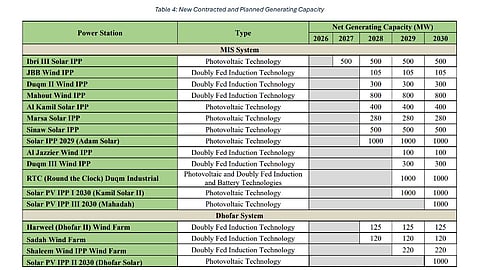
According to a statement issued in June 2026, Oman plans to add at least 4 utility-scale solar PV projects of 1 GW each. The projects are planned at Adam in Al Dakhiliyah, Al Kamil Phase II in Al Kamil, Dhofar Solar II in Thamrait, and Mahadah Solar Project in Mahadah, taking the total planned solar PV capacity under this pipeline to 4 GW.
Beyond these, it also plans to add several smaller-scale solar projects, including the 500 MW Ibri Solar III, the 400 MW Al Kamil I, the 280 MW Marsa Solar, and the 500 MW Sinaw Solar facilities.
Nama Power and Water Procurement recently launched a request for qualification round for the Adam and Wilayat Sinaw solar projects (see Oman Launches RFQ For 1.5 GW Solar PV Projects).
According to OETC's statement, all of these projects are scheduled to come online between 2026 and 2030, increasing the share of installed generation capacity from renewable energy sources from 13.6% in 2026 to 45% in 2030, according to the OETC. At the end of 2025, Oman's total installed solar PV capacity had reached 1.67 GW, as per the International Renewable Energy Agency (IRENA).
The agency, co-owned by the Oman government and China’s state-owned State Grid Corporation of China, plans to support the country's growing renewable energy portfolio by expanding the country’s transmission network and adding battery energy storage systems (BESS).
Some of the large-scale BESS projects included in the plan include 1,000 MW/2,000 MWh in MIS, 250 MW/1,000 MWh in Dhofar, and 500 MW/2,000 MWh also in MIS.
Currently, OETC says Oman is implementing 2 flagship BESS projects at Ibri and Duqm, each with a storage capacity of 500 MW/2000 MWh, designed to support a wide range of ancillary services. Both projects are on track to be commissioned by Q2 2026.
“Most projects are designed to increase transmission system capacity to meet future demand growth, integrate new generations of renewable and conventional resources, connect new rural areas, serve bulk customers, and meet Transmission Security Standards,” reads the report.
OETS CEO Hisham Abdullah Al Riyami said that storage systems will support peak shaving and that its phased deployment reflects a forward-looking grid modernization strategy.
Oman also aims to become a global green hydrogen hub by using its renewable energy resources to support decarbonization, economic diversification, and energy security. The country targets 1.0 to 1.5 million tons of green hydrogen production annually by 2030 and up to 8.5 million tons by 2050, attracting over $140 billion in investments.
Recently, Nama Power also released its 2025 Annual report, under which it targets the country’s first large-scale 24/7 renewable energy project combining solar, wind, and battery storage technologies (see Oman Plans 1 GW 24/7 Renewable Energy Project).
