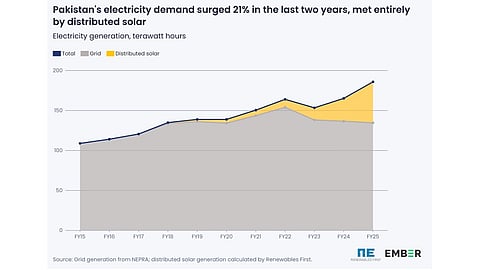


Distributed solar met all of Pakistan's electricity demand growth between FY23 and FY25, according to a new report
This pushed Pakistan's electrification rate to 21.7%, close to the global average of 22%
The report says affordable electricity, storage, and grid upgrades will be key to sustaining future electrification
Pakistan has moved close to the global average for electrification after a rapid expansion of distributed solar transformed its energy system over the past 2 years, according to a new report by Ember and Renewables First.
Over FY23-FY25, Pakistan installed 27 GW of the 38 GW of distributed solar. This, according to the report writers, is equivalent to the total installed capacity of all coal, gas, and oil plants ever built in the country. The report maps installed capacity across 4 sectors – residential, industrial, agricultural, and commercial – focusing on FY23 (July 2022-June 2023) through FY25 (July 2024-June 2025).
The surge in solar lifted Pakistan's electrification rate – the share of final energy demand met by electricity – to 21.7% in FY25, close to the global average of 22%.
According to the report titled The solarization of Pakistan’s energy economy, official energy statistics have largely overlooked the growth of distributed solar, but its analysis found that distributed solar played a central role in increasing electricity use rather than simply replacing grid power.
Between FY23 and FY25, Pakistan's total electricity demand increased by 21%, equivalent to 33 TWh. It was led entirely by distributed solar generation that rose from 15 TWh to 51 TWh, contributing 36 TWh of additional generation. This contributed to reducing grid electricity generation by 3%.
The report writers estimate that distributed solar's share of the electricity mix increased from 10% in FY23 to 28% in FY25. After accounting for transmission losses, distributed solar supplied around 32% of the country's electricity.
Its proliferation has expanded electricity use across the agricultural, industrial, residential, and commercial sectors by improving access to lower-cost power. In agriculture alone, solar has largely displaced diesel and grid electricity, while in the industrial sector, it has ‘filled the vacuum’ left by the collapse of captive gas and coal with its competitive price advantages.
The residential segment is another big proponent of solar, and so is the commercial segment. A TaiyangNews analysis finds that residential and C&I adoption will primarily drive rooftop solar in Pakistan (see Pakistan: Rooftop Solar Helps Tackle Fuel Supply Disruptions).
“Transportation, which has so far remained largely untouched by the shift, is becoming the next frontier of electrification,” according to the report.
“Distributed solar was cheaper – residential solar with a medium battery produces electricity at around PKR 20 per kWh, half the PKR 40 cost of grid electricity,” reads the report. “Distributed solar was better – it has eliminated daytime loadshedding, avoided more than $12 billion USD in oil and gas imports by February 2026, reduced CO2 and air pollution and saved transmission and distribution losses.”
The report says distributed solar can support further electrification if electricity remains affordable, reliable, and accessible. It notes that wider deployment of batteries, grid upgrades, and continued investment will be needed to provide round-the-clock (RTC) power.
At the same time, rooftop space constraints in the country mean utility-scale renewable energy will also play an important role in meeting future demand.
“Rooftop potential is estimated at 310 TWh, and with generation at 51 TWh, 17% of the potential is already used,” point out the analysts.
The complete report is available for free download on Ember’s website.
