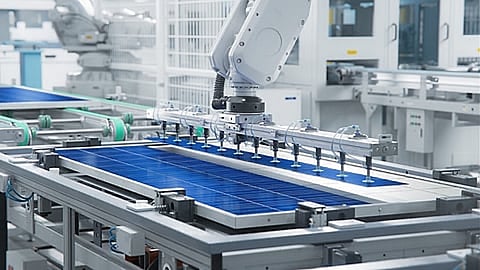


China is reportedly discussing limits on exporting advanced solar manufacturing equipment to the US
The EU, on the other hand, is considering restricting funding for projects using Chinese inverters, factoring in industrial and security concerns
Both developments highlight a broader shift toward regional solar PV supply chains
Emerging reports suggest that China is reportedly considering new measures to safeguard its dominance in the global solar PV manufacturing sector, while the European Union (EU) is moving to limit the role of Chinese solar inverters in its clean energy projects. The developments, though not yet officially confirmed, signal potential shifts in trade dynamics across key solar markets.
According to a Reuters report, Chinese officials have held early talks with equipment manufacturers about limiting exports of advanced solar panel production equipment to the US.
China not only accounts for over 80% of the world’s solar component supply across the supply chain but is also home to the world’s top 10 solar cell manufacturing equipment suppliers, says Reuters.
Local media reports in China also cite undisclosed industry sources claiming that equipment manufacturers have been contacted by provincial authorities who discussed stopping deliveries of already signed orders and avoiding signing new contracts with US clients. They have reportedly been told not to export certain equipment.
The reports specifically mention a 10 GW order already agreed with Chinese suppliers and a larger 40 GW order under discussion that could be impacted. Rumor has it that these orders could relate to Tesla’s plans to purchase Chinese PV manufacturing machines to feed its 100 GW solar capacity plan for the US.
Elon Musk-led Tesla and SpaceX are separately working on building up to 100 GW/year of solar PV manufacturing in the US, including for up to 1 million solar-powered AI satellites (see Elon Musk Says SpaceX, Tesla Eye 100 GW/Year US Solar Manufacturing).
In March 2026, Tesla was reportedly in talks with Chinese companies, including the heterojunction solar manufacturer Suzhou Maxwell, to purchase machinery worth $2.9 billion to produce solar cells and modules in the US (see North America Solar PV News Snippets).
The US has been keeping Chinese supply out of its solar supply chain with trade tariffs and investigations to boost the local manufacturing industry. However, the country is struggling to scale up its upstream manufacturing and remains dependent on outside suppliers, with China at the top.
The US knows this and also that there is a limited supply of the requisite equipment outside China. Therefore, USTR’s Section 301 tariffs, extended till November 10, 2026, exclude certain solar manufacturing equipment, including silicon growth furnaces for growing solar ingots and wafers, band saws, and diamond wire saws (see US Extends Section 301 Tariff Exclusions For Solar PV).
China is also aware of this. By preventing the export of its proven, cheaper solar PV manufacturing equipment to the US, as the reports suggest, it could slow the US’s plans to build its own manufacturing capacity to scale. The US manufacturers will have to pay higher costs for non-Chinese equipment, while China also addresses its overcapacity issues back home by limiting the expansion of new global capacity.
Such a move would also prevent any strong overseas competitors for the Chinese, especially since the other upcoming global solar PV manufacturing hub, India, is exploring machinery cooperation with the Europeans.
Recently, in an exclusive interview with TaiyangNews, Subrahmanyam Pulipaka, the CEO of NSEFI, said that India has a strong opportunity to collaborate with European equipment manufacturers. He sees an opportunity to manufacture equipment in India for both domestic use and export markets (see NSEFI Exclusive: India Will Be World’s 2nd-Largest Solar Market In 2026).
Nevertheless, the development remains unconfirmed. When asked by a Reuters reporter at the April 16, 2026, press conference of the Chinese Ministry of Commerce (MOFCOM), the ministry’s spokesperson said he was unaware of such a development.
Meanwhile, in another part of the world, Chinese solar inverters are facing resistance in the EU. The European Commission has reportedly approved a plan to stop the bloc from funding projects that deploy Chinese solar inverters.
According to a South China Morning Post report, the commission wants to curb research cooperation under its Horizon program where Chinese inverters are involved.
On the one hand, it will help support the local manufacturing industry, and on the other, the step may be related to fears of China blocking power supply to the EU via its inverters, since inverters are considered the heart and brain of solar systems. Hence, these inverters may pose a security risk for the EU’s power system.
Last year, Reuters reported that the US was reassessing risks posed by Chinese-made solar inverters after it detected ‘rogue communication devices’ in some of them, including cellular radios. Such components could be accessed remotely, potentially causing a security breach by circumventing firewalls.
According to the report, the EU is taking a quieter ‘do more, say less’ approach on China, focusing on low-profile policies to cut reliance and counter industrial overcapacity while avoiding retaliation. The European inverter manufacturers could see this as an opportunity to grow, supported by EU policy and funding.
The situation remains uncertain and depends on official decisions. Any changes, however, could influence global solar supply and project timelines.
