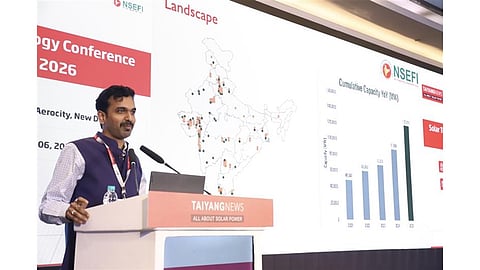


In an exclusive interview with TaiyangNews, National Solar Energy Federation of India (NSEFI) CEO Subrahmanyam Pulipaka says India is on track to become the world’s 2nd-largest solar PV market this year.
Following a record 45 GW AC of additions in FY 2025–26, installations are expected to approach 50 GW AC in 2026 (see India Adds Record 45 GW Solar PV Capacity In FY 2026). He attributes this growth to strong policy backing and earlier aggressive bidding. State-led procurement, C&I demand, and distributed solar are expected to sustain momentum.
TaiyangNews: India recorded a landmark FY 2025–26 with 45 GW AC of annual solar PV additions, taking cumulative capacity beyond 150 GW AC. What factors do you attribute this growth to?
Subrahmanyam Pulipaka: The strong performance in FY 2025–26 aligns with projections we had made earlier. From FY 2025–26 onwards, higher capacity additions were expected, driven largely by the aggressive bidding strategies adopted in 2023. This was further supported by a series of regulatory and policy measures introduced over the past 2–3 years, including initiatives around green energy and open access, as well as schemes such as PM Surya Ghar and PM Kusum.
Together, these factors have had a cumulative impact, enabling India to achieve one of its most record-breaking years in solar installations.
It is also worth noting that India is among the few countries that report installed capacity in AC terms. On a DC basis, installations are close to 65 GW for the year.
At this pace, India is approaching the total installation levels of the European Union as a bloc and, as a single country, is on track to surpass the United States soon.
TaiyangNews: In 2026, most industry estimates suggest India will become a 50 GW AC solar market. As the industry body, what are your expectations for the market this year?
Subrahmanyam Pulipaka: We expect India to emerge as the second-largest solar market globally this year in terms of annual installations. Our forecast indicates that annual installations will be close to 50 GW in AC terms, which translates to roughly 65–70 GW on a DC basis.
TaiyangNews: What are the major drivers and limitations for this year?
Subrahmanyam Pulipaka: We see a few key developments – largely positive, though they come with certain requirements.
First, states have now jumped onto the renewable energy bandwagon. We are seeing more state-specific bids and more aggressive procurement. With the ISTS waiver having sunset, states are looking to build more capacity within their own boundaries. This creates an opportunity for more balanced, distributed growth of renewable energy across states. However, it also means we need to strengthen the transmission infrastructure at the state level. State transmission development will be critical going forward.
Second, on manufacturing, India has done very well in modules and is getting closer in cells. But upstream – wafers, ingots, polysilicon, and even equipment – we still need to accelerate. This is more of an opportunity than a challenge. Measures like extending ALMM to wafers and ingots can help, and we have suggested dedicated viability gap funding (VGF) for these capital-intensive segments. With the right support, India could become one of the most economical producers globally.
Third is the commercial and industrial (C&I) segment. This year, close to 25% of capacity additions have come from C&I, which is a record, and the segment has entered double digits. This will continue to grow. However, there is a need for better cohesion across states. We have been advocating for a national-level council, similar to the GST Council, to harmonize charges, surcharges, and regulations, at least for C&I, to improve ease of doing business.
So these 3 factors – state-led bidding, upstream manufacturing, and C&I growth – are the key levers.
Additionally, based on our estimates up to 2030, India could overperform its solar targets. Against the 280-300 GW AC target within the 500 GW renewable goal, solar capacity could exceed 320 GW AC.
TaiyangNews: So it is realistic?
Subrahmanyam Pulipaka: Yes, it is realistic. We are now actively considering that solar could outperform the 2030 targets and help India reach 500 GW faster.
TaiyangNews: Recently, a report indicated that around 60 GW of capacity is stuck in a single state due to the lack of transmission grid capacity. The Indian solar market is still largely utility-focused. Since transmission infrastructure cannot change overnight, where do you see room for improvement?
Subrahmanyam Pulipaka: Transmission is the backbone of our energy transition; there is no transition without transmission. What we are experiencing right now is more of an aberration and, in my view, will last about 6 to 8 months. There is currently a mismatch between the pace of renewable energy capacity additions and that of transmission expansion, largely due to the rapid growth in RE. But this is a temporary phenomenon, and I am not as concerned about transmission as it is sometimes portrayed.
We are already seeing alternative growth hubs emerging. Rooftop solar is picking up, distributed renewable energy is growing, and the C&I segment is expanding. These will help balance the growth. So, beyond the next 6 to 8 months, I do not see transmission as a major concern.
As a country, we should also recognize that we operate the world’s largest high-voltage synchronized grid, which is not easy to manage. The government and all stakeholders are working towards strengthening it. I am confident that by the first quarter of the next financial year, we will be in a much better position.
That said, capacity additions will not slow down. Installations will continue to grow, and we expect to keep outperforming our annual addition targets year after year.
TaiyangNews: With the ongoing Middle East crisis and many countries accelerating the adoption of alternative energy, how is India positioned in this situation?
Subrahmanyam Pulipaka: India has 2 key opportunities in this context. First, for the first time in our history, we are power surplus; we have more capacity than we consume. This means the focus now should be on activating demand: creating new demand hubs and increasing electricity consumption.
Second, if you look at India’s overall energy mix, only about 18-20% is electricity, while the rest is still dependent on fossil fuels like oil and gas. This gives us a historic opportunity to electrify large parts of our consumption, whether it is cooking, industrial heat, or agriculture.
In many ways, India has been less impacted by the current crisis because we have been structurally decarbonizing in a phased manner. For example, in agriculture, we have already replaced a significant number of diesel pumps, reducing dependence on diesel. Similarly, for power backup, we expect a shift from diesel generators to solar-plus-storage solutions over the next couple of years.
With energy storage scaling up, backup power will increasingly come from rooftop solar, commercial installations, and other solar-based systems. This is a major opportunity for India. Even electrifying cooking alone could create an additional 12–14 GW of demand. Since we already have surplus capacity, the system is ready to support this transition.
Overall, India is relatively insulated from global disruptions because of its long-term focus on renewable energy. Unlike many countries that are now accelerating their transition, India has been steadily building its renewable energy base over the past decade, which is now paying off.
TaiyangNews: I think India has also had the opportunity to learn from the mistakes of other markets as they scaled.
Subrahmanyam Pulipaka: Yes, definitely.
TaiyangNews: Coming to manufacturing, the MNRE recently said that India’s module production capacity has reached around 172 GW. From NSEFI’s perspective, is this capacity being fully utilized today?
Subrahmanyam Pulipaka: When we look at the ALMM list, we need to be mindful of 2 things. First, it is an exhaustive list of all approved models and manufacturers; it represents the total available capacity, not necessarily what is fully utilized at any given time. Second, there is a difference in how we measure installations and manufacturing.
Installations are measured in AC, while manufacturing capacity is in DC, which already creates a gap of around 40%. For example, last year India installed about 45-46 GW in AC terms, but in DC terms this would be at least 63-65 GW, possibly even higher. So this difference needs to be considered when assessing utilization.
That said, while module manufacturing has scaled up significantly, the real focus now should be on upstream segments. At the same time, module manufacturing will continue to evolve with technology advancements.
As NSEFI, we believe market forces should largely determine how capacity is utilized. With measures like ALMM for cells and upcoming ALMM for wafers in 2028, there is a clear trajectory from the government. If additional incentives are provided and the sector is developed from a broader ecosystem perspective, India can further strengthen its domestic manufacturing, especially in upstream areas.
TaiyangNews: Do you expect consolidation in the industry? Will it become a market dominated only by large players?
Subrahmanyam Pulipaka: Market consolidation in India is somewhat of an oxymoron. If you look at our economy, both large retail chains and small kirana (local convenience shops) stores coexist and serve different customer segments. You don’t typically see large players entirely replacing smaller ones.
The same analogy applies to the solar sector: different players serve different markets. There are many segments that often go unnoticed. For instance, solar street lighting, off-grid systems in remote and border villages, and other decentralized applications don’t always get reflected in mainstream capacity addition numbers. Yet, these are important markets served by smaller manufacturers and players.
The solar ecosystem in India is quite well segmented: rooftop, agricultural pumps, off-grid systems, street lighting, cold storage, utility-scale, and C&I. Each segment has its own niche, and different players operate successfully within them.
So, beyond natural consolidation, I do not see the market becoming dominated only by large players. While numbers may sometimes suggest consolidation, in reality, there is space for everyone. MSMEs, in particular, remain the backbone of the sector and will continue to play a key role across segments.
TaiyangNews: Talking about cells, once ALMM is implemented for cells, do you expect sufficient availability of high-quality cells in India, especially given that prices may initially be higher?
Subrahmanyam Pulipaka: The ALMM list for cells is evolving continuously, with updates coming in regularly. We are closely monitoring how cell manufacturing capacities are developing on the ground, including whether the efficiencies required by installers are being achieved in time.
At this stage, it is still too early to make a clear assessment. The list needs to mature further before we can determine whether sufficient high-efficiency capacity is available. Given that India’s annual installation demand is around 50 GW AC – translating into around 70 GW DC – we need to see how domestic cell supply aligns with this scale. At this moment, it'll be difficult to tell what efficiencies are and whether they're matching expectations.
TaiyangNews: What is a realistic timeline for upstream integration, and how can India get there?
Subrahmanyam Pulipaka: Ideally, given the pace of growth, we should have achieved stronger upstream integration by now. The pace at which India is adding capacity is accelerating rapidly; it took 11 years for the first 50 GW, 3 years for the next 50 GW, and we believe it will take just about 14 months for the next. The next 50 GW could come in under a year.
Realistically, however, ingot and wafer manufacturing may scale up by around 2028–29, while polysilicon could take until 2030–31.
To get there, we need to approach manufacturing as a full ecosystem—from mining and raw materials to machines and final modules. In addition to viability gap funding (VGF), support such as subsidized electricity for manufacturing and domestic development of equipment will be important. While R&D is critical, in the near term the focus should be on rapidly building domestic capacity across the value chain.
TaiyangNews: How is the industry looking at manufacturing equipment supply? Could the India-Europe FTA make Europe a major partner?
Subrahmanyam Pulipaka: Europe will remain a key partner for India, not just because of a potential FTA but also due to its growing solar ambitions and its view of India as a strategic partner.
There is a strong opportunity for collaboration in equipment manufacturing. European countries have significant experience, and India can partner with them to co-develop next-generation solar technologies. NSEFI has already initiated discussions with countries like Germany and Italy, and plans to engage with the UK as well.
We also see an opportunity to manufacture equipment in India for both domestic use and export markets, which could strengthen India’s position in the global solar value chain.
TaiyangNews: The US has traditionally been the largest solar market for Indian exports. With the US becoming more protectionist, which export markets is India now targeting?
Subrahmanyam Pulipaka: You are right. The US has traditionally been India’s largest export market, but recent developments have made that relationship more challenging.
However, this has opened up new opportunities. Markets in the Middle East, Africa, and Latin America are emerging as important destinations. Europe is also a strong opportunity, especially with its evolving policies and manufacturing push.
In addition, Southeast Asia, East Asia, Oceania, and island nations are transitioning from oil to clean energy, offering further export potential. We are actively working to build B2B linkages between Indian companies and these markets.
TaiyangNews: A common concern across the industry is the lack of skilled labor which was also discussed during the TaiyangNews Solar Technology Conference India 2026 (STC.I 2026) by leading industry executives. How is this being addressed?
Subrahmanyam Pulipaka: Skill development is a major priority. NSEFI is launching a dedicated manufacturing-focused curriculum on April 30, 2026, to support its members in accessing skilled workers.
The challenge is broader, as manufacturing capacity across sectors has expanded rapidly in recent years. We need a multi-pronged approach: targeting blue-collar workers through ITIs and vocational training, while also developing white collar jobs for engineers and specialists in areas like material science.
Both workforce segments are critical, not just for current manufacturing needs but also for handling next-generation technologies. Institutions like NISE have already developed training programs, but much more needs to be done to meet the growing demand.
TaiyangNews: What policy measures are needed to make the Indian solar PV industry more predictable and globally competitive?
Subrahmanyam Pulipaka: There are 3 key priorities.
First, policy stability and standardization. While central policies are supportive, variations at the state level, such as differing charges and regulations, create uncertainty. A national-level council, similar to the GST Council, could help harmonize policies and improve ease of doing business.
Second, manufacturing support. We need dedicated VGF for upstream segments and a broader ecosystem approach covering everything from mining to modules, machines, and materials.
Third, energy storage. The next 2 years will be critical for storage deployment. To support this, India needs stronger market mechanisms, including the development of ancillary markets.
As India moves toward becoming one of the world’s largest solar markets, and potentially the second-largest in installed capacity within the next few years, its regulatory and market frameworks must evolve accordingly.
Affordable and accessible electricity is central to economic development. With renewable energy and storage, India has a unique opportunity to strengthen its power system and accelerate its transition toward becoming a developed nation.
TaiyangNews: Thank you.
Subrahmanyam Pulipaka was among the speakers at TaiyangNews STC.I 2026 where he stressed the need for India to focus on long-term energy security and independence (see STC.I 2026: Continuing India’s Solar PV Manufacturing Momentum).
