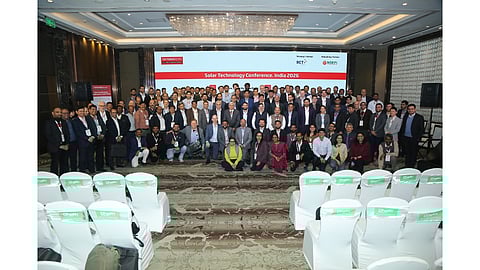


Speakers during the inaugural session on day 1 of the TaiyangNews STC.I 2026 said India could emerge as one of the world’s top solar manufacturing hubs as capacity expands across modules, cells and upstream components
Technology shifts and electrification are expected to increase global electricity demand
Industry representatives from organizations including NSEFI and TERI said India should reduce dependence on imports for wafers and polysilicon while expanding exports beyond the US
Experts highlighted the need for stronger policy support, increased R&D, and development of solar recycling to manage future waste and create new economic opportunities
India’s solar PV market had grown exponentially over the last few years, driven mostly by the government support via policy framework as well as protectionist measures. What more does it need now to expand further, is something experts discussed over the 2-day TaiyangNews Solar Technology Conference India 2026 (STC.I 2026). The 2-day event brought together industry leaders, policymakers and technology providers in New Delhi on February 5–6 to discuss the future of solar manufacturing and innovation. With so many insightful sessions and talks spread over the 2 days, we bring you the coverage in several parts to be published over the next few days.
Here we cover the inaugural session on day 1 of the conference Solar Manufacturing in India – Reflecting on the Strategy to Solar Autonomy.
TaiyangNews Managing Director Michael Schmela officially opened the event with the launch of the TaiyangNews Market Survey Report on Solar Module Production Equipment 2026, available for free download here.
Schmela set the tone of the conference when he said, “The buzzword is Electrostate. Even though some countries prefer to be powered by fossil fuels, the future is being electric because it means you are clean, independent and resilient. Solar, for being efficient and low-cost, is obviously the key to quickly get on to the electrification highway.”
Keynote speaker Peter Fath, Founder and CEO of RCT Solutions GmbH, echoed Schmela’s thoughts that the future of solar PV is strong as global electrification, robotics, and AI will increase electricity demand. Solar energy, being quick to deploy, efficient, and cost-effective, is well positioned to meet this demand.
Fath praised Indian solar manufacturers for their resilience and described India as a global powerhouse and a key hope for the solar industry. He sees India as emerging to take place among the top 3 solar manufacturing hubs globally. It could even become the 2nd largest since Southeast Asia, which was previously ranked 2nd as a region, is declining due to tariffs and the lack of a strong domestic market.
He projected that India could become the world’s 2nd-largest solar PV manufacturing hub, with annual module capacity expected to grow from 80 GW in 2025 to 160 GW by 2030. By then, cell capacity could reach 120 GW, while wafer and polysilicon capacities may each expand to 100 GW.
While TOPCon remains the current mainstream technology, Fath advised Indian manufacturers to prepare for next-generation technologies such as back contact (BC) cells. He also encouraged companies with sufficient resources to invest in small laboratories to explore perovskite tandem technologies and develop their own intellectual property.
Fath stressed that India should expand domestic production of components like glass and cables to strengthen its role in the global clean energy value chain, especially amid improving trade conditions between India, the EU, and the US.
At the same time, he highlighted the importance of reducing the carbon footprint of manufacturing as a key future challenge for the industry.
Building on Fath’s points, National Solar Energy Federation of India (NSEFI) CEO Subrahmanyam Pulipaka stressed that even though India is taking a strategic approach to protection in the solar sector, it must now focus on long-term energy security and independence.
Pulipaka explained that while India has expanded exponentially in the module space with progress in cell production, the country continues to remain highly dependent on China for wafers (with around 2 GW domestic capacity) and has no polysilicon production of its own so far. This he described as a critical vulnerability and an unsustainable path for energy security.
Pulipaka said India should view its module overcapacity as an opportunity to expand into upstream manufacturing and global markets. He added that India is no longer a developing country in the solar industry and should position itself to compete strongly in the global market.
He welcomed the government’s budget proposal for special incentives to support machinery manufacturing in India. Pulipaka pointed out that European technology is currently being used by Chinese companies to produce solar PV machinery. Now India should collaborate with European partners for technology development and R&D.
Referring to the proposed EU-India Free Trade Agreement touted as the “Mother of All Deals,” Pulipaka urged India to leverage it to manufacture solar PV production equipment domestically.
Picking up on Pulipaka’s thread of module overcapacity, The Energy and Resources Institute (TERI) Director of Electricity & Renewables Alekhya Datta and Associate Researcher Aniket Tiwari emphasized that India must use its nearly 144 GW module production capacity to expand its export presence, beyond the US.
They agreed that strengthening vertical integration is a no-brainer for the country to lower its reliance on imports for upstream components.
They noted that policy measures such as PLI, ALMM, and BCD have supported scale-up the purpose for which these were designed, but the next step is to build a complete ecosystem to ensure long-term competitiveness.
For this vertical integration to take place in a sustainable fashion, government policy support is a must. Mahesh Murthy, Group CTO of Waaree Group Murthy said manufacturers currently receive only 3 years of benefits under the Production Linked Incentive (PLI) scheme, but full 5-year entitlement will work better in their interest.
He also noted that demand for Domestic Content Requirement (DCR) modules remains limited and called for new DCR-specific projects over the next 12 months, along with faster execution of pending CPSU tenders to boost demand for Make in India products.
Stronger enforcement and compliance monitoring under the Approved List of Models and Manufacturers (ALMM) is a must along with measures to discourage import-heavy EPC-led procurement practices, including steps to manage module imports from FTA countries, he stressed. These measures will also create more demand for Make in India modules.
Murthy also called for advancing the implementation of ALMM List-III for solar wafer compliance from June 2028 to June 2027 to strengthen domestic manufacturing standards.
“I think increased investments in R&D, but also industry, academia, engagements need to be focused on outcomes, which are commercial outcomes, not just technical learnings and some minor improvement. We need to be looking at being future ready in terms of technology. So that's the key,” stressed Murthy.
Speaking of technology, recycling is one such domain that offers an economic opportunity like no other. It can deal with waste challenges while also attracting investment and creating jobs, provided these are supported by the right policies, according to Ajinkya Kale the Programme Associate from the Council on Energy, Environment and Water (CEEW).
Kale shared that India could generate 11 million tonnes of cumulative solar waste by 2047 with most likely to come from high-deployment states such as Rajasthan, Gujarat, Karnataka, Tamil Nadu and Andhra Pradesh. By 2047, recycling could meet up to 38% of raw material demand for India’s solar sector, representing a market opportunity of about INR 3,700 crore, and avoid 37 million tonnes of carbon emissions.
Currently, recycling is financially unviable due to high operating expenses, especially waste procurement costs, which account for almost 56% to 68% of total costs. If manufacturers supply waste modules free of cost, mechanical recycling could generate about INR 17,000 per tonne and chemical recycling about INR 15,000 per tonne compared to a loss of around INR 10,000 per tonne and INR 12,000 per tonne, respectively.
Extended Producer Responsibility (EPR) certificate trading under India’s e-waste rules could help turn recycling profitable. Clear EPR targets for solar waste and expansion of eligible materials could improve project economics, said Kale.
Globally, companies such as First Solar have integrated recycling into their business models. Kale recommended that for India, stronger regulatory clarity, technology development and proactive industry participation will be essential to build a competitive and resilient solar recycling ecosystem.
Day 1 of the event also had a policy panel and an executive panel with speakers from leading companies and industry experts joined in to discuss the challenges and opportunities for India’s solar PV industrial growth. There was an interesting session on Market Overview—Supply, Demand and Price Dynamics on day 2. Here are the 10 key takeaways from this session (see India’s Defining Moment: Soaring Demand Meets Surging Supply).
TaiyangNews will be back with this year’s 1st Virtual Conference on Smarter Solar for Homes & Businesses on March 25, 2026. Registrations are open here.
