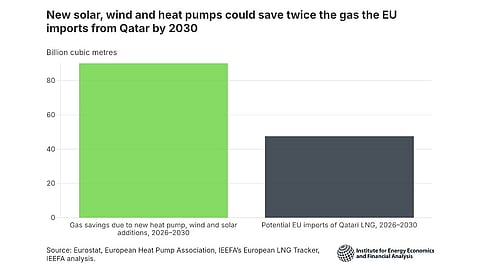


According to a new IEEFA report, installing at least 75 GW of solar, 22 GW of wind, and 4 million heat pumps annually could reduce the EU's gas demand by around a quarter by 2030
The resulting gas savings would be equivalent to twice the volume of LNG the EU could potentially import from Qatar by the end of the decade
The analysis says accelerating clean energy deployment and grid investment would help the bloc in achieving its long-term electrification goals
Faster deployment of solar, wind, and heat pumps could help the European Union (EU) cut its natural gas demand well beyond the potential contribution of new LNG imports, according to a new analysis by the Institute for Energy Economics and Financial Analysis (IEEFA).
The EU targets at least 75 GW of solar, 22 GW of wind, and 4 million heat pump installations annually by 2030. Meeting these targets alone could bring down the bloc’s gas demand by 25% by the end of this decade, and generate gas savings double the volume of LNG the EU could import from Qatar during the period, claim the analysts.
IEEFA believes that clean energy has helped offset the EU’s dependence on LNG imports. In 2024, solar, wind, and heat pump generation helped bring down the EU’s gas demand by 8.8 billion cubic meters (bcm), equivalent to about two-thirds of its Qatari LNG imports that year.
Qatar is an important supplier of LNG to Europe. Damage to its export facilities due to the war in the Middle East has made it clear that the EU must reduce its gas demand and offset the need to import LNG by accelerating the rollout of wind, solar, and residential heat pumps. “This is the most effective way to structurally reduce Europe’s reliance on volatile fossil fuel imports,” advises IEEFA.
According to SolarPower Europe, solar helped cut the EU’s gas import costs by €20 billion between March 1, 2026 and July 15, 2026 (see Solar Saved EU €20B In Gas As Bloc Pushes Electrification). It earlier projected 19.9 TWh of solar energy generation within the initial 17 days of the Middle East conflict in 2026 to have saved the bloc about €112 million/day in avoided fossil fuel imports (see EU Saved Over €100 Million/Day With Solar During Middle East Conflict).
According to IEEFA analysts, if the EU achieves its heat pump, solar, and wind installation targets, these three technologies together could cut gas demand by around a quarter by 2030. This saving is equivalent to double the volume of LNG the EU could import from Qatar by 2030.
Gas savings will continue as clean energy installations further expand. This, along with grid investment, will also push the bloc towards meeting its 2040 electrification target and bring down the threat to its energy security.
As per the EU’s Electrification Action Plan, the bloc plans to achieve a 46% electrification target by 2040, which the European Commission believes could help it cut gas imports by more than 70% and crude oil imports by 40%.
“Clean energy investments can mitigate energy supply risks, whether from disruptions in the Strait of Hormuz or the supply gap created by the EU’s full ban on imports of Russian gas, which takes effect in 2027,” says Ann Maria Jaller-Makarewicz, IEEFA Europe’s Lead Energy Analyst.
