

Europe’s solar market showed more resilience than expected in H1 2026, despite a challenging policy environment, according to SolarPower Europe
The association has raised its 2026 forecast, but says a lot depends on policy and market conditions
Utility-scale solar is gaining a larger role, while rooftop deployment faces growing pressure from weaker residential demand
Europe’s solar market showed unexpected resilience in H1 2026, but SolarPower Europe says the improvement was driven more by the energy crisis than by stronger policy support, which is the need of the hour.
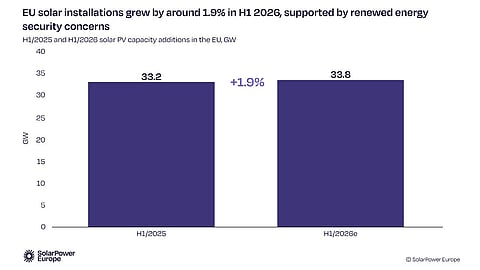
In its EU Solar Market Update: 2026 Mid-Year Analysis, SolarPower Europe says the bloc installed nearly 33.8 GW of solar PV capacity, up about 1.9% year on year (YoY). This was slightly higher than the 33.2 GW reported in H1 2025. The increase was mainly due to external factors driven by renewed energy security concerns and higher fossil-fuel prices due to the Middle East conflict.
Although fewer member states led this capacity addition, it was sufficient to support overall EU market growth.
The five largest markets – Germany, Spain, France, Italy and Poland – accounted for about three-quarters of H1 installations. Poland recorded the strongest growth among the five, with installations up 39% YoY, while Italy grew 10% and France 5%. Germany and Spain, on the other hand, were down 4% and 6%, respectively, although the report notes that these figures could be revised as more project registrations are reported.
Based on the data available now, SolarPower Europe expects 68.1 GW of solar capacity to be added in 2026, an increase of 6.6 GW over 61.5 GW it projected in December 2025. The updated guidance is still 2.1% below the revised 2025 record of 69.6 GW, up from the 65.1 GW it reported earlier. The revision mainly reflects a revised installation figure of 13.4 GW for Spain, up from 9.2 GW reported earlier (see EU Solar Growth Slows With First Annual Dip Since 2016). The report's low and high scenarios for 2026 range from 62 GW to 74.1 GW, depending on market and policy conditions.
The report authors expect utility-scale projects to account for 56% of new EU solar capacity in 2026, compared with 44% for rooftop systems, down from 45% in 2025. SolarPower Europe blames the projected decline in rooftop solar on weakening residential demand in several markets as support schemes become less attractive or more uncertain. Commercial and industrial (C&I) solar has proved more resilient, with companies continuing to invest to reduce electricity costs and hedge against future price volatility.
Michael Schmela, Executive Advisor and Director of Market Intelligence at SolarPower Europe and Project Lead for the report, said the H1 figures should be viewed against the broader market environment rather than as a return to strong growth.
Schmela stated, “H1 2026 has once again demonstrated that higher fossil fuel prices strengthen the business case for solar. But the fact that market resilience has been supported by another external energy shock rather than stronger policy and regulatory frameworks remains a warning sign for the sector’s long-term growth prospects.”
The expansion of solar in Europe is increasingly constrained by negative electricity prices, grid bottlenecks and insufficient battery storage. While storage could help absorb excess midday generation and enable further solar deployment, regulatory barriers, limited grid capacity, and a lack of clear business models are slowing its development.
The report highlights that solar's role in Europe is expanding beyond decarbonization. From March 1 to August 31, the EU’s solar PV generation totaled 282 TWh, which SolarPower Europe estimates avoided about €30 billion in gas import costs for power generation.
Solar also became the EU’s largest source of electricity in June, supplying a record 25% of generation. It provided more than 20% of the EU’s electricity in May, June, and July. The timing was important, the association remarks. Heatwaves increased demand for air conditioning, while high river temperatures and low water levels constrained some nuclear and hydropower generation.
Solar therefore produced strongly as demand rose and some conventional generation came under pressure.
However, Europe is adding solar faster than it is adding the flexibility needed to use it effectively. Without flexibility resources and with grid connection constraints, the market is seeing negative electricity prices, declining solar capture rates, and rising curtailment. These in turn increasingly affect project revenues.
Walburga Hemetsberger, CEO of SolarPower Europe, stressed, “Europe should not need an energy crisis to make the case for solar, and it should certainly not weaken the conditions for solar investment in the middle of one. Policymakers must now focus on the fundamentals: grids, storage, flexibility and stable investment frameworks.”
Increasing storage deployment will increase the value of solar and reduce reliance on fossil fuel generation outside solar hours. SolarPower Europe expects EU battery storage installations to reach 52 GWh in 2026, up about 44% from 36 GWh in 2025.
SolarPower Europe argues that the current policy environment does not provide enough certainty to sustain the investment needed for the next phase of solar growth. The association maintains that the EU is likely to miss its 750 GW solar target for 2030 by a ‘significant margin’ under current market and policy conditions.
“Our assessment therefore remains unchanged: under current market and policy conditions, the EU is not on track to meet its 2030 solar target,” says SolarPower Europe.
The complete report is available for free download on SolarPower Europe’s website.
