

SolarPower Europe’s report stresses the need to expand and support Europe’s BOS manufacturing advantage
It says BOS will play a growing role in storage integration, electrification, digitalization, and meeting rising system flexibility requirements
It recommends EU-origin requirements for inverters, harmonized standards, stronger cybersecurity, and greater recognition of mounting structures and trackers
The EU had 96.4 GW of inverter manufacturing capacity in 2025, against an estimated demand of 56 GW
SolarPower Europe has called on European policymakers to strengthen the region’s domestic manufacturing of solar balance of system (BOS) components and improve regulatory support for this sector, where the region already has a strong manufacturing presence.
Simply put, BOS components comprise all the equipment in a solar PV system other than the modules themselves. These include solar inverters, mounting structures and trackers, cables, connectors, and other electrical and structural components required to install and operate a solar power plant.
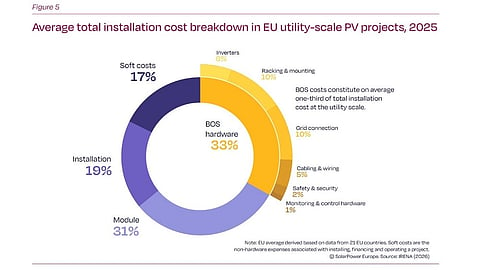
BOS today makes up 33% of the value of a completed solar project, compared to 31% for modules, according to the association. In absolute terms, in 2025, BOS hardware, including inverters, accounted for an average of 33% of total installation costs for utility-scale solar projects in the EU, equivalent to €241/kW. Grid connection and mounting structures each accounted for 10% of costs, followed by inverters at 6%, cabling and wiring at 5%, safety and security at 2%, and monitoring and control hardware at 1%.
SolarPower Europe emphasizes the need to strengthen this segment as BOS components are expected to play a growing role in storage integration, electrification, digitalization, and meeting rising system flexibility requirements.
Walburga Hemetsberger, SolarPower Europe CEO, calls it an industrial opportunity for Europe. She stated, “Despite the difficulties along the module value chain, Europe retains substantial expertise and manufacturing capabilities in solar BOS technologies. These strengths deserve recognition and conditions that support their continued development.”
Europe currently has the second-largest share of global inverter production capacity. In 2025, the EU’s inverter manufacturing capacity had reached 96.4 GW, more than enough to meet the demand of 56 GW. Yet, Europe still relies on both imports and exports rather than a fully domestic supply chain. European manufacturers continue to face competition from high-performance inverters produced globally with the advantages of economies of scale.
In April 2026, the European Commission reportedly approved a plan to block EU funding for solar and battery storage projects using inverters from high-risk countries, including China, citing cybersecurity concerns. SolarPower Europe has since sought clarification on the decision, citing uncertainty over its scope and justification (see SolarPower Europe Seeks Clarity On EU Inverter Funding Ban).
In a new report, SolarPower Europe makes a number of recommendations to maintain and grow Europe’s manufacturing advantage in the BOS space. These include introducing EU-origin requirements for PV inverters, harmonizing inverter standards, recognizing inverters’ role in providing grid flexibility and stability, and strengthening solar cybersecurity.
The report also recommends including fixed mounting structures and trackers in the EU’s list of strategic net-zero technologies. The measures also call for better trade tracking of mounting structures and trackers.
Michael Schmela, Executive Advisor and Director Market Intelligence, SolarPower Europe, said, “A proportionate implementation of such measures would strengthen European capabilities while preserving solar’s affordability.”
The complete report, titled Solar Balance of System Explained: The hidden components enhancing solar generation, is available for free download on SolarPower Europe’s website.
Speaking of BOS, TaiyangNews reviews the inverters and power electronics, along with the latest energy storage products, unveiled at SNEC and Intersolar this year in its New Balance of System (BOS) Components 2026 report. It is available for free and can be downloaded here.
