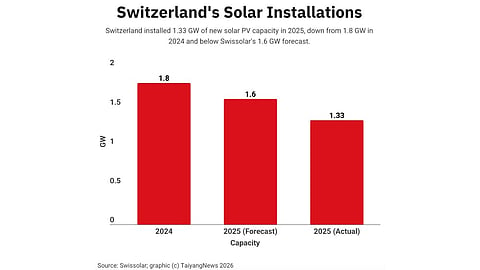


Switzerland's solar market lost momentum in 2025 despite reaching a major renewable energy milestone, according to Swissolar
Battery storage emerged as a key growth driver, which Swissolar says highlights its increasing role in the country's energy transition
Swissolar is urging policy reforms to support future solar PV deployment; it expects installations to stabilize this year at the 2025 level
At the end of 2025, Switzerland’s cumulative installed solar PV capacity expanded to 9.5 GW, generating nearly 8 TWh of electricity, or 13.7% of the country's final electricity consumption.
Solar remained the largest contributor in terms of electricity production among new renewable energy sources last year, excluding hydropower, of 10 TWh. By 2050, the country targets 45 TWh of renewable energy generation (see Switzerland Bats For 45 TWh RE Production In 2050).
However, the pace of solar PV deployment slowed during the year, according to Swissolar. New PV installations of 1.33 GW in 2025 declined 26% from 1.8 GW in 2024. The solar energy association says this marks the first annual contraction in the country’s annual solar installations since 2017. It is even lower than the association’s own forecast for 1.6 GW annual additions (see Swissolar Forecasts Up To 1.6 GW Solar Capacity For Switzerland In 2025).
Swissolar attributes the slowdown to policy uncertainty and changing electricity market conditions, including lower daytime power prices that have increased the importance of local energy storage.
Battery storage recorded strong growth, with 490 MWh of new capacity installed in 2025, up 70% year-on-year. More than 93,000 battery systems were operating by the end of the year, providing a combined storage capacity of about 1.38 GWh.
On the other hand, annual battery storage installations grew significantly. The country installed around 27,800 new battery energy storage systems (BESS) with nearly 490 MWh of capacity, taking its total installed storage capacity to 1.38 GWh across about 93,500 systems – up 70% in added capacity and 42% in the number of systems compared to 2024.
“Distribution network operators must create incentives for grid-friendly operation of battery storage systems through dynamic supply and demand tariffs and ensure intelligent operation through standardized data protocols. At the federal level, a national storage strategy must be developed and implemented quickly,” demands Swissolar.
It expects PV installations to stabilize in 2026 while battery storage additions could double again.
In May 2026, Switzerland’s Federal Council approved new energy rules to encourage use of battery storage and self-consumption of solar electricity by linking feed-in remuneration more closely to market prices. The new rules are scheduled to come into force from January 2027 (see New Swiss Rules Encourage Battery Storage Growth).
