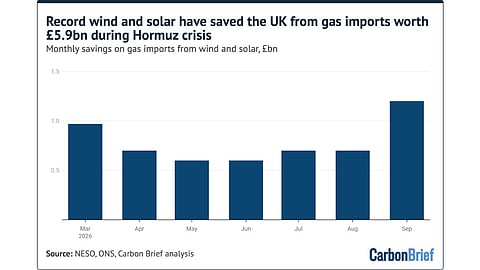


Wind and solar generation helped the UK avoid an estimated £5.9 billion in gas import costs since the start of the Hormuz crisis, according to Carbon Brief
The UK saved about £1.3 billion in gas import costs in the month of September
Wind and solar supplied a record 41% of the UK's electricity till the end of September 2026, compared to 25% from gas
The UK has saved an estimated £5.9 billion in gas import costs since the start of the Strait of Hormuz crisis, as record wind and solar generation reduced the need for gas-fired power, according to a Carbon Brief analysis.
In September alone, the UK saved about £1.3 billion in gas import costs as wind and solar generation reached nearly 10 TWh, the analysis showed. “These avoided gas imports would have required the UK to secure the equivalent of more than 100 additional tanker deliveries of liquefied natural gas (LNG),” stated Carbon Brief.
Wind and solar generation have increased by 14% year-on-year (YoY) since the 2022 energy crisis, while gas prices have risen sharply over the same period. Together, the two renewable sources accounted for a record 41% of the UK's electricity generation to date in 2026 (September 30, 2026), compared with 25% for gas, the analysis said.
In an earlier analysis, SolarPower Europe said that solar cut the EU’s gas import costs by €20 billion between March 1, 2026 and July 15, 2026 – since the start of the West Asia conflict (see Solar Saved EU €20B In Gas As Bloc Pushes Electrification).
The Labour Party-led government in the UK has been pushing for faster adoption of clean energy since the crisis began, to help households save on energy bills and reduce the country’s dependence on global fossil-fuel markets. As part of this push, the government legalized plug-in/balcony solar across England, Scotland, and Wales on August 27, 2026. Northern Ireland is expected to follow suit (see Plug-In Solar Panels Become Legal Across Great Britain).
Recently, the government said the Great British Grid (GBG) under Great British Energy will speed up grid connections for clean power generation to support growing demand from households and businesses. It will also bring in reforms to allow developers and businesses to build their own connections instead of waiting for network companies.
“The government is already working with NESO and Ofgem to reform the connections system, including overhauling the connections queue and removing more than 300 GW of speculative capacity,” stated the Department for Energy Security and Net Zero.
Among other measures, the government also announced the Future Homes Standard to make new homes install solar panels and low-carbon heating, calling it a ‘common-sense’ measure. It is set to come into force on March 24, 2027, and run till March 24, 2028 (see New England Homes To Have Solar Panels ‘By Default’).
However, the Conservative Party in the UK has unveiled plans to abolish the Future Homes Standard if it comes to power. Trade association Solar Energy UK has pushed back against such a plan.
“Everyone can see that solar and batteries are the quickest and most effective way for families to take back control of their energy bills. I would urge the Conservatives to reconsider abandoning a policy that they were instrumental in developing. It is far cheaper to design and build a new home with solar panels than having families pay to retrofit afterwards,” said Chris Hewett, Chief Executive of Solar Energy UK.
