
- Markets
- Business
- People
- Opinion
- Technology
- Storage+
- Reports
- Our Events
- Tenders
- Price Index
- Top Modules
- ServicesServices
- AnalysisAnalysis

India now has 1 of only 5 national primary solar cell calibration facilities in the world
The new lab will allow Indian solar manufacturers to get accurate, internationally accepted calibration done within the country
It is aimed at supporting India’s fast-growing solar manufacturing sector by cutting costs, time, and reliance on foreign testing agencies
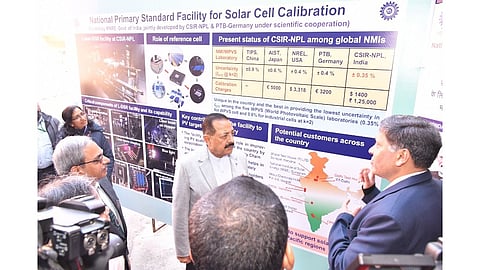
India has become a member of the ‘elite global league’ in solar metrology with the launch of the National Primary Standard Facility for Solar Cell Calibration. This is the world’s 5th such facility. The other 4 facilities are TIPS in China, AIST in Japan, NREL in the US (now NLR), and Physikalisch-Technische Bundesanstalt (PTB) in Germany.
Previously National Renewable Energy Laboratory (NREL), the US government has renamed it as the National Laboratory of the Rockies (NLR).
The Solar Cell Calibration facility has been developed in collaboration with PTB, Germany. It operates a laser-based Differential Spectral Responsivity (L-DSR) system that the NPL claims achieves the lowest uncertainty globally of 0.35% (k=2) for reference solar cell calibration.
The facility has come up within the CSIR-National Physical Laboratory (NPL), along with the National Environmental Standard Laboratory, the world’s 2nd such lab, which will enable reliable, India-specific calibration and certification of air pollution monitoring systems. CSIR-NPL is the custodian of National Standards and maintains the Indian Standard Time (IST).
At its inauguration, the country’s Union Minister of State for Science & Technology, PMO Department of Space and Department of Atomic Energy, Dr. Jitendra Singh, called the Solar Cell Calibration facility ‘future-ready’. It places India among a select group of global leaders in photovoltaic measurement standards.
India’s solar PV manufacturing capacity is growing by leaps and bounds, having added 81 GW of module capacity in 2025, reaching a total of about 144 GW, while cell capacity has grown to 24 GW (see India Adds 81 GW Solar Module Manufacturing Capacity In 2025).
Singh said this will reduce India’s dependence on foreign certification agencies. It will also save foreign exchange and shorten the calibration turnaround time. It also enhances investor confidence in the country’s rapidly expanding solar sector, he added.
TaiyangNews is bringing together the Indian solar PV manufacturing industry for the Solar Technology Conference India 2026 (STC.I 2026). To be held on February 5 and 6 in Aerocity, New Delhi, this 2nd edition of the TaiyangNews physical conference will also have banks, investors, and policymakers in attendance, including the Deputy Director General at the Government of India’s National Institute of Solar Energy (NISE), Dr. Jai Prakash Singh. Register for the event here.
