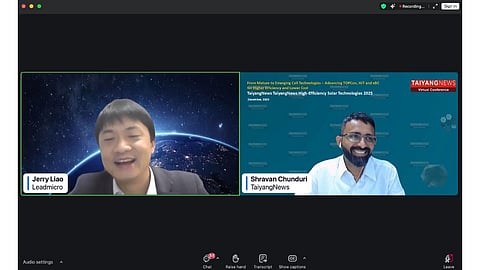


The jury is still out on which solar PV cell technology is the best of the lot since each one of them – TOPCon, Back Contact (BC), and Heterojunction (HJT) – have their own strengths and shortcomings. TaiyangNews, at its annual flagship event, High Efficiency Solar Technologies 2025 Conference, brought together leading industry leaders and stakeholders to delve deep into these technologies, one day at a time.
On December 3, 2025, Day 1 discussions revolved around BC technology. In a fireside chat with Leadmicro CTO Jerry Liao, TaiyangNews Head of Technology Shravan Chunduri reflected on the main challenges for BC to become a mainstream technology. Here’s an edited version of the chat:
TaiyangNews: Solar technology is no longer uniform across regions. As an equipment supplier with close visibility into manufacturing trends, how do you see solar cell technology evolving overall?
Jerry Liao: Solar cell technology is evolving very quickly, with noticeable changes every year. Today, several technologies coexist, and this will likely continue for the next few years because each option has advantages and limitations. There is no single best technology. BC has strong potential to become the next mainstream cell technology, but its challenges still need to be resolved. The focus now is on maximizing its strengths while reducing costs, which is why new process routes are being introduced to lower cost contributors.
TaiyangNews: What are the top 3 technology trends you have seen over the last 12 months in cell technology?
Leadmicro: First, TOPCon continues to progress. EPD polyfinger technology is moving toward maturity, and the efficiency gap between TOPCon and BC is narrowing. There is also potential for further upgrades, including bipoly structures. Second, BC has become a major focus of R&D, driven by leading manufacturers who are pushing it toward mass production. Third, tandem technology is gaining strong momentum, with increasing pilot projects and market interest.
TaiyangNews: You recently visited India and met potential customers. What were your key observations, and what concerns did Indian manufacturers raise most often?
Jerry Liao: India’s solar market is very active, similar to China several years ago. However, challenges remain. There is a shortage of skilled manpower, and factory infrastructure, supply chains, and the overall ecosystem are still developing. Running a cell production line is much more complex than module manufacturing, and this lack of experience is a key concern.
TaiyangNews: Were there any inquiries about BC technology in India?
Jerry Liao: Most manufacturers are currently focused on deploying TOPCon lines, but many are already asking about future upgrade paths to BC. Some are also considering BC pilot lines, but large-scale adoption is still at an early stage.
TaiyangNews: How has industry perception of BC technology changed over the last 12 months?
Jerry Liao: The market share of BC is expected to increase, but the pace is relatively slow. Unlike the rapid shift from PERC to TOPCon, BC adoption is more gradual. This suggests that more investment and resources are needed to address BC’s limitations. Financial pressure in the Chinese market has also slowed new investments. Still, most companies now agree that BC will be an important part of future technology portfolios.
TaiyangNews: What would you say are the top 3 technology innovations in BC during this period?
Jerry Liao: First, laser-based patterning has become mainstream, helping to simplify the process, although photolithography may play a role in the future.
Second, edge passivation remains a challenge for BC, which is why some manufacturers are using half-cell designs. Third, metallization is critical, especially reducing silver usage and finger thickness, as metallization is a major cost contributor. In addition, new PCVD-based poly processes show promise, with more results expected next year.
TaiyangNews: In terms of efficiency, what is the realistic gap between the best TOPCon and the best BC cells today?
Jerry Liao: At present, the efficiency difference is about 1%. Over the next 1 to 2 years, this gap may narrow or remain similar, depending on how both technologies develop. If BC achieves further breakthroughs, the gap could widen; otherwise, it may stay close.
TaiyangNews: What is your rough estimate of the cost difference between TOPCon and BC?
Jerry Liao: The cost gap between TOPCon and BC is narrowing. Improving TOPCon efficiency requires increasingly complex processes, which adds cost. At the same time, BC manufacturing costs are coming down as equipment becomes more tailored and efficient. As a result, both technologies are moving closer in overall cost.
TaiyangNews: Equipment capex is also an important cost factor. You mentioned a CapEx figure for BC earlier. How does TOPCon compare today?
Jerry Liao: It is difficult to give a fixed number because TOPCon is also evolving, with new versions and added processes. Each upgrade increases cost. At the moment, TOPCon costs are increasing, while BC costs are decreasing.
TaiyangNews: What are the main cost drivers for BC that differ from TOPCon?
Jerry Liao: From an equipment supplier’s perspective, the main drivers are tool costs and process complexity. Laser patterning, in particular, is expensive due to there being a limited number of suppliers. Reducing equipment barriers, especially for laser processes, is critical to lowering BC costs.
TaiyangNews: BC seems to have an advantage in low- or silver-free metallization. Would you like to add anything to this topic?
Jerry Liao: Metallization is a major cost factor in cell manufacturing. While copper plating is promising, it is complex and costly. Other options, such as silver-coated copper, could serve as intermediate solutions by significantly reducing silver consumption. The key challenges now are process integration and yield stability.
TaiyangNews: From an Indian perspective, is it realistic to upgrade state-of-the-art TOPCon lines to BC?
Jerry Liao: Technically, it is possible. Economically, it depends on factors such as equipment age, upgrade feasibility, and availability of spare parts. Each case needs to be evaluated individually.
TaiyangNews: Yield is critical for commercialization. What is the current status of process yield in BC?
Jerry Liao: This topic is very sensitive, and it is better discussed offline.
TaiyangNews: Are there any major unresolved technical bottlenecks that could slow the widespread adoption of BC?
Jerry Liao: BC is already ready for mass production, as shown by leading manufacturers. Like all technologies, it still requires continuous improvement. There is no perfect technology, and both TOPCon and BC will continue to evolve.
TaiyangNews: Since you are offering turnkey BC production lines, how proprietary is BC technology today?
Jerry Liao: Patents are an important consideration, especially when selling products in certain markets. Leading players hold strong BC patent portfolios, so manufacturers must carefully evaluate IP risks before investing.
TaiyangNews: From a CapEx and factory layout perspective, how different is a BC line compared to a modern TOPCon line?
Jerry Liao: BC production lines differ significantly in layout and process flow. Some utilities and factory infrastructure can be reused, but many tools need modification or relocation. Planning is complex, and manufacturers must consider future technology changes when making decisions.
TaiyangNews: If you had to give manufacturers one key piece of advice before investing in BC, what would it be?
Jerry Liao: There is no need to rush. Start with TOPCon, and if you are interested in BC, begin with a pilot line.
TaiyangNews: Is the approach to BC different in China compared to other regions?
Jerry Liao: Yes. In China, BC is more mature and can be adopted more quickly. However, BC must succeed in the utility-scale market to become truly mainstream, as rooftop and distributed markets alone are limited.
TaiyangNews: Finally, what is needed to make BC the next mainstream solar cell technology?
Jerry Liao: First, BC must maintain an efficiency advantage of at least 1%. Second, it must be cost-competitive in terms of total power output and investment return. Third, it must penetrate the utility-scale market. Meeting these 3 conditions is essential for BC to become mainstream.
TaiyangNews: Thank you.
A summary of all 4 days of the TaiyangNews event, along with conference details are available here.
