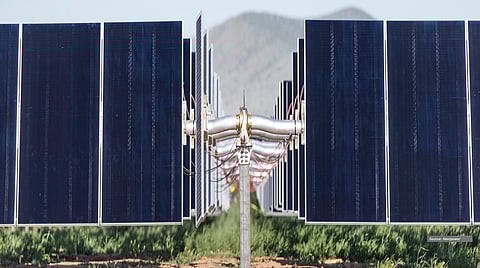


Solar trackers have moved from being an optional performance enhancer to a structural component of utility-scale PV. With global deployments reaching 112 GW in 2024 – roughly a third of the annual PV utility-scale market that year – the segment is firmly embedded in mainstream solar development.
The US remains the anchor market, where more than 90% of ground-mounted utility-scale projects utilize trackers. India and the Middle East have emerged as the most dynamic growth engines, supported by strong irradiation, large project sizes, and competitive tendering structures. The picture in Europe is more nuanced: while tracker penetration is increasing, leading markets such as Spain are entering a phase defined less by capacity expansion and more by system integration challenges, including grid congestion, negative pricing, and curtailment.
This structural shift is redefining the value proposition of trackers. Beyond incremental energy yield, trackers enable production-profile management – flattening midday peaks, improving shoulder-hour generation, and enhancing price capture. In high-penetration markets, the economic discussion is moving from pure LCOE optimization toward system value optimization. In this context, battery storage is emerging as the key flexibility tool, while trackers are starting to be seen as a complementary lever within this equation.
Technologically, the tracker segment is entering a new phase of differentiation. While mechanical engineering remains critical, performance gaps at the hardware level are narrowing. Competitive advantage is migrating toward control intelligence: AI-assisted tracking, predictive algorithms, adaptive backtracking, terrain-aware positioning, and integrated plant-level monitoring. Yield optimization under diffuse irradiance, real-time stow logic, and autonomous weather response are becoming baseline expectations rather than premium features.
Configuration trends confirm the 1P architecture as the dominant utility-scale format. Its structural simplicity, compatibility with robotic cleaning, and cost efficiency make it the preferred solution across most markets. The 2P format continues to serve targeted use cases, including agrivoltaics, bifacial optimization, and land-constrained sites. Independent-row architectures are increasingly favored over mechanically coupled designs for operational flexibility and simplified maintenance.
Agri-PV represents one of the most structurally relevant adjacent growth areas. Trackers enable infrastructure for dual-land-use models with adjustable row spacing, higher clearance, and flexible tilt behavior. As land availability tightens and permitting complexity rises, this segment could become strategically more important in the coming decade.
Resilience engineering has evolved into a central pillar of tracker design. Stowing strategies have transitioned from fixed safety angles to sophisticated, site-specific, weather-responsive systems integrating CFD modeling, aeroelastic validation, sensor fusion, and predictive control logic. As extreme weather events increase in frequency and severity, resilience may become a decisive procurement criterion – particularly in hurricane-, hail-, or snow-prone regions.
Terrain-following capabilities have similarly shifted from niche differentiator to industry standard. As flat land becomes scarce, developers increasingly expect trackers to adapt to site conditions rather than reshape them. The competitive edge now lies in minimizing earthworks, accelerating installation, and optimizing lifecycle costs through integrated mechanical and software solutions.
On the commercial side, the segment appears to be approaching material optimization limits. Further cost reduction will likely stem less from steel intensity and more from logistics optimization, installation efficiency, digital commissioning, and supply-chain localization. Domestic-content mandates – primarily in the US and India – are reshaping manufacturing strategies and influencing supplier positioning. Tracker suppliers are evolving into industrial platform providers rather than pure hardware vendors.
Looking ahead, the tracker segment is unlikely to be defined by radical mechanical reinvention. Instead, its trajectory will be shaped by intelligent refinement: deeper software integration, predictive performance modeling, resilience optimization, and tighter coupling with storage and grid services.
Trackers are no longer simply mechanical devices that follow the sun. They are evolving into adaptive, data-driven energy management platforms that enhance both power output and the functional value of solar power within increasingly complex electricity systems. Add in battery storage, and trackers are poised to become a foundational layer of flexibility infrastructure in grids with high solar penetration.
The text is the conclusion part of the TaiyangNews latest Markey Survey on Solar Trackers 2026, which can be downloaded for free here.
