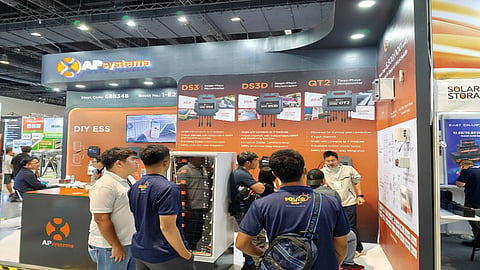

APsystems debuted its S3 series microinverter for the residential market in the Philippines
The company introduced the EZ1 and EZH1 series plug-and-play microinverter and hybrid micro storage system, respectively, for balcony PV and DIY applications
It promoted the QT2 series 3-phase microinverter for C&I users
Module-level power electronics (MLPE) and micro solar-plus-storage system provider APsystems unveiled its latest offerings at the Solar & Storage Live Philippines 2026 exhibition.
The company introduced the new S3 microinverter for residential prosumers in the country. This inverter, equipped with a single MPPT channel, is compatible with a PV module up to 700 W. Its solar DC capacity can be inverted to 1-phase AC power of up to 500 VA, once its AC port is directly plugged into the prosumer’s plug-point. Its power electronics components are housed in an IP68-rated enclosure, thereby enabling long-term outdoor field operation. The product can be easily added to existing microinverter-based PV modules without alteration in system cabling or design, facilitating flexible capacity expansion.
The company also displayed commercially available 1-phase microinverters DS3 and DS3D. The former connects to 2 PV modules up to 660 W each via its 2 independent MPPT channels to deliver up to 880 VA AC power. The latter, featuring 2 MPPT channels, each supporting 2 PV modules, delivers up to 1,800 W of output power. Both microinverters have a rated maximum conversion efficiency of 97%. They use the encrypted Zigbee communication protocol for device-to-device wireless remote communication. These products, when AC-coupled with the company’s residential storage systems, the Solar Battery Hybrid Controller AHS 6.3 automatically schedule solar, battery, and grid power. It is suitable for areas with unreliable grid supply, noted APsystems.
The company also promoted its EZ1 series plug-and-play microinverter, designed for balcony PV and DIY applications. It comprises 2 MPPT channels, each carrying a PV module, and delivers a cumulative AC capacity of 960 W. This microinverter can be connected directly to the user’s cell phone via Bluetooth to view real-time system data. Besides, it can connect to a Wi-Fi router and share data with cloud servers for remote monitoring.
Also on display was a 1-phase hybrid storage microinverter, EZH1, designed for DIY solar systems. It can store excess solar generation from 2 connected PV modules via the integrated battery storage system. As the hybrid system is compatible with various PV microinverter systems, it can be easily added to an existing balcony plug-and-play setup. On the operation side, it provides emergency backup to a few domestic loads during a sudden grid outage.
For commercial & industrial (C&I) applications, the company pitched its QT2 microinverter (3-phase) and liquid-cooled energy storage system (ESS), APstorage 261L. The microinverter with its 2 MPPTs and 4 input channels delivers a maximum AC power of 2,000 VA.
These products feature a module-level rapid shutdown system (RSD), APsmart. It quickly sends a signal to the microinverter upon detecting system anomalies, which then rapidly disconnects the PV systems from the faulty system as a preventive measure.
The commercialization details of these showcased products were unknown at the time of this article’s publication.

