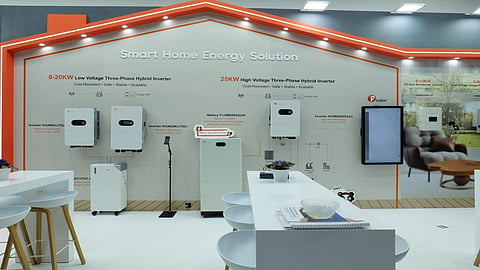

Felicitysolar promoted its IVGM20KLP3G1 3-phase hybrid inverter and FLB series FLB48314TG1 battery bank, among other showcases
The 20 kW inverter can export excess generation to the grid, while it can be configured for a zero-export function
It is designed to deliver emergency backup and ToU charging/discharging functions
Felicitysolar, a China-based residential and commercial & industrial (C&I) inverter and energy storage system (ESS) provider, displayed its product lineup differentiated by application at Intersolar Europe 2026.
A highlight among the company’s products on display was its IVGM20KLP3G1 3-phase hybrid inverter combined with its FLB series FLB48314TG1 lithium-iron-phosphate (LFP)-based battery bank for residential prosumers. The inverter is rated for up to 20 kW power output (3-phase) at full-load current, irrespective of the energy sources – storage, PV, or grid. The above-mentioned battery bank is equipped with 314 Ah LFP cells and is rated for 16 kWh of energy storage and discharge capacity at a maximum of 160 A via the inverter. Given the inverter’s maximum charging/discharging capacity of 350 A, a 20 kW/32 kWh residential ESS can be formed by connecting 2 battery banks in parallel. These batteries have a life of more than 8,000 cycles.
On the PV side, the inverter consists of 2 MPPTs and allows up to 160% DC/AC oversizing to maximize PV generation throughout the day. The excess generation, which is beyond captive demands, is rerouted to storage in real time and maximizes the prosumer’s self-consumption. In case of a fully charged battery storage, this excess power can be fed into the grid. The inverter can also be configured for zero export function. The embedded algorithms of the inverter’s built-in energy management system (EMS) can schedule battery charging/discharging according to the dynamic grid tariff or time of use (ToU) to optimize energy cost. In the event of a grid outage, it switches the inverter to off-grid mode within 4 ms to provide emergency backup for a duration that matches the battery discharge capacity. The hybrid inverter has a maximum conversion efficiency of 98%. According to the company, users can install the Fsolar app, a visual and monitoring interface, which provides real-time status and data, as well as historical trends.

