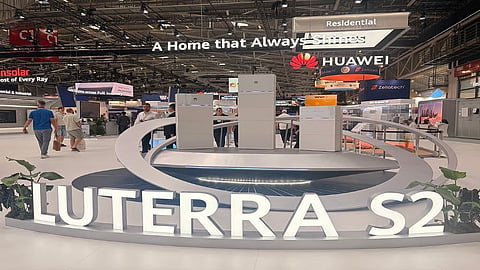

Huawei unveiled its latest SiC-based residential PV + ESS product, LUTERRA S2, at Intersolar Europe 2026
Its battery bank can feature 5 or 7 kWh packs and provide a range of 3-phase power outputs of 5 to 20 kW
The company has slated this product for commercial availability in November 2026
Ahead of the commercial launch in Europe in November 2026, the President of Residential PV & ESS Business at Huawei Digital Power, Sun Power, launched a new residential PV + ESS product, LUTERRA S2, at Intersolar Europe 2026.
The company highlighted the adoption of SiC-based power switching devices, ease of installation, and cell-to-system-level safety functions as the product’s key features.
The Huawei product combines a 3-phase SiC-based hybrid inverter and vertically stacked battery banks in a single enclosure. Users can connect 4 LUTERRA-5/7-E2 series battery packs of 5 or 7 kWh each, with LUTERRA-5/6/8/10/12/15/17/20K-XM0 series inverters, offering a power output range of 5 to 20 kW. According to the company, these packs are up to 17% lighter, and the system covers up to 0.6 m² smaller wall spaces than their counterparts. It attributes these advantages to the adoption of Silicon Carbide (SiC)-based power switching devices instead of Insulated Gate Bipolar Transistors (IGBTs). These devices, which have a wider bandgap and higher breakdown voltage, offer faster switching speed and cooler operation in smaller sizes and reduced power losses, the company added.
In terms of installation, it can be fully installed within 10 minutes without any on-site wiring and remotely commissioned in less than 5 minutes, like a conventional home appliance, the company claimed.
From an operational perspective, its energy management system (EMS) features AI-assisted energy scheduling software, AI Scheduling 2.0. The company stated that the software algorithm teaches itself about the patterns of user load consumption, weather forecasting, regional dynamic electricity tariffs, and others. This updated algorithm optimizes scheduling of PV self-generation, battery charging or discharging, EV Charging, and heat pump operation in real-time by leveraging its intelligence. Additionally, the system offers an AI chatbot for users’ convenience.
For safety purposes, the system features a full-link terminal overheat detection, which is likely to extend beyond battery cell monitoring alone. It covers over-temperature protection at connection points such as battery terminals, busbars, power connectors, and cable connections. Unlike the conventional home ESS, this new product is equipped with a venting duct that can vent smoke in a specific direction, according to the product details shared by the company.
TaiyangNews team was on the trade show floor covering real-time updates about the displayed products in a live blog (see Live Blog - TaiyangNews Live from The smarter E / Intersolar Europe 2026).

