

JA adopts common power conversion hardware for PV inverters and battery storage PCS
The JANebula digital platform uses AI for safety, maintenance and revenue optimization
An aquaculture project in Italy combines 5.2 MW of solar capacity with 2.61 MWh of battery storage
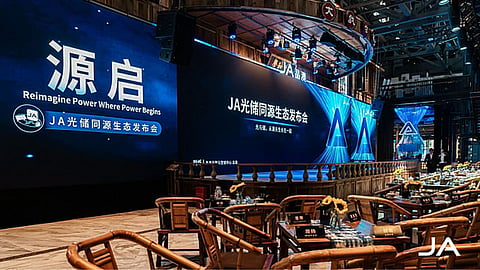
Solar module manufacturer and energy storage solutions provider JA has launched its Same-Origin Solar and Storage Ecosystem. Under this approach, the company develops PV and storage products together rather than integrating separately developed products at the project level.
One of the highlights of the launch is the PV-storage inverter and step-up integrated unit. According to JA, the PV inverter and battery storage power conversion system (PCS) share a common enclosure and hardware design. Depending on the project requirements, the number of modules allocated to PV and storage can be changed through software. This also requires corresponding changes to wiring, protection and control parameters. Connecting up to 8 modules in parallel takes the total power capacity to 6.9 MW.
JA already offers both AC- and DC-coupled storage solutions for commercial and industrial (C&I) applications. In the new architecture, low-voltage AC coupling allows the PV inverters and storage PCS to share an AC bus and voltage step-up infrastructure. Compared to conventional PV-plus-storage systems, JA estimates an improvement in system efficiency of 2% to 3% and savings of up to 3% in initial equipment costs. The company also estimates that onsite deployment and commissioning time can be cut by 20% to 30%, while operation and maintenance (O&M) costs can be reduced by 10% to 20% (see JA ESS’s AC- & DC-Coupled C&I ESS At Intersolar).
As Shou Liu, President of JA’s Brand & Marketing Center, pointed out, the performance of a PV-plus-storage system is not determined by equipment performance alone. Component compatibility and power dispatch also play an important role. JA’s approach involves joint research and development (R&D), coordinated operations, pre-commissioning before shipment and integrated after-sales service. The company estimates these measures can reduce project management costs over the system’s lifetime by 30%.
The importance of storage and digital controls in bringing greater flexibility to electricity supply was also discussed by JA ESS Marketing Director Gloria Gao at the TaiyangNews Solar Power Plants & Storage Conference 2026 (see JA ESS Links Utility-Scale Solar Value To Storage And Flexibility).
JA manages energy flows through its JANebula digital platform. Besides supporting real-time power dispatch, the platform provides a common data model, control logic and communication interfaces. It incorporates artificial intelligence AI in 3 areas – safety, O&M, and revenue optimization. Electricity price and demand forecasts, along with battery degradation costs, are taken into account when determining when to charge and discharge the batteries. The platform can provide fault warnings 7 to 10 days in advance, according to JA, which also reports an anomaly detection accuracy of at least 96% (see JA Highlights Integrated PV And Storage Solutions).
On the product front, JA’s utility-scale portfolio comprises 5 MWh and 6.26 MWh containerized battery energy storage systems (BESS), along with centralized and string-type AC step-up units. For C&I applications, JA offers standalone storage and PV-storage all-in-one units, both rated at 125 kW/261 kWh, and a 250 kW/522 kWh split PV-storage system. Residential storage products are available in 5 kWh and 16 kWh capacities. In all, the ecosystem covers 8 application areas, including data centers, mining, agriculture and microgrids.
JA’s storage systems for harsh operating environments support a temperature range of –30°C to 55°C and operation at altitudes of up to 4,000 m, subject to power derating. The systems incorporate protection against sand ingress, with C5-level corrosion protection available as an option. The battery cabin is rated IP55 and the battery packs IP67. At the pack level, JA reports a maximum temperature difference of 2.39°C.
In December 2025, JA announced an integrated PV and storage project at an aquaculture facility in Sicily, Italy. The facility already had 3.2 MW of solar capacity but faced limited grid capacity and high electricity costs. The project adds another 2 MW of PV and 2.61 MWh of battery storage, allowing the facility to make better use of the solar power generated onsite. The batteries also provide emergency backup power for critical loads.
JA also analyzed the economics of adding 375 kW/783 kWh of battery storage to a 1 MW C&I rooftop solar project. The model prioritizes onsite solar power consumption and battery charging using PV power, assuming a storage system efficiency of 87% and a depth of discharge (DoD) of 95%. Compared to the PV-only project, adding storage increases the initial investment by around 35% but reduces the modeled payback period from 11.13 years to 7.98 years and increases the internal rate of return (IRR) from 7.15% to 9.76%.