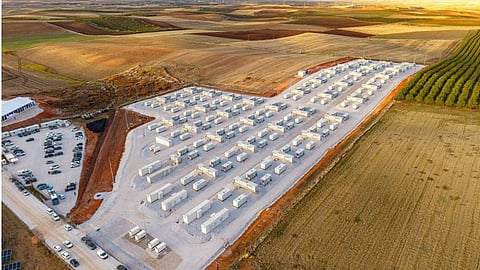


Greece has commissioned a 330 MW standalone BESS facility with 790 MWh of storage capacity
METLEN and Karatzis Group developed the project through a joint investment vehicle
Greece aims to have up to 4 GW of energy storage projects operating or under implementation by 2028
METLEN Energy & Metals, previously MYTILINEOS, along with Greek industrial enterprise Karatzis Group of Companies, have commissioned a 330 MW project calling it the largest standalone battery energy storage system (BESS) in Greece.
Located in Larissa, Thessaly, the BESS facility is backed by a loan from the EU’s Recovery and Resilience Facility, NextGenerationEU. It was built by a joint investment vehicle between METLEN (49%) and Karatzis (51%). METLEN is responsible for the construction, operation, and maintenance of the Thessaly facility.
The project is expected to support grid infrastructure, improve energy connectivity, system resilience, and support more efficient use of renewable energy generation, the partners stated. It will also help attract investment in Greece and Europe.
At the project’s inauguration, Greece’s Prime Minister Kyriakos Mitsotakis called it a critical project that can help contain and provide competitive electricity. “We want to have 3-4GW of projects operating or being implemented in storage units by 2028. And of course, these can be either batteries or pumped storage projects,” stated Mitsotakis.
With 790 MWh storage capacity, the project is also one of the largest facilities of its kind in Europe, they add. In August 2026, Copenhagen Infrastructure Partners (CIP) launched a 500 MW/2-hour BESS project in Scotland, calling it Europe's largest operational battery, but now much larger projects are under construction.
Very recently, in September 2026, Greenvolt launched construction of a 600 MW/2.4 GWh BESS project in Poland, due to enter commercial operations by the end of 2027.
The European Union (EU) targets 200 GW of storage capacity by 2030, up from 55 GW in April 2026 (see AccelerateEU Backs 200 GW Storage Ambition by 2030). In a new report, Ember says the EU and China together account for more than 80% of national storage targets worldwide (see Global Storage Targets Reach 822 GW, 45% Below COP29 Goal).
