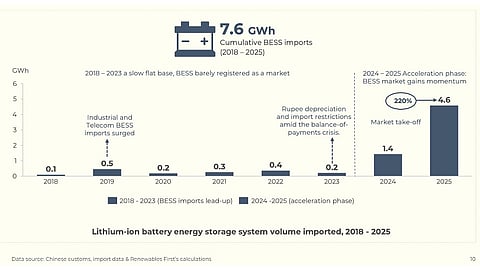


Pakistan's lithium-ion BESS imports surged 220% YoY to 4.6 GWh in 2025, according to a new Renewables First report
The boom is driven by falling battery prices, booming rooftop solar adoption, and high electricity tariffs
While households dominate the market, commercial, industrial, and telecom segments are also driving rapid growth in BESS imports
Pakistan's energy storage market is gaining momentum as lithium-ion battery energy storage system (BESS) imports jumped 220% year-on-year (YoY) to 4.6 GWh in 2025.
To put it in context, Pakistan’s total lithium-ion BESS imports between 2018 and 2025 totaled 7.6 GWh, with the residential segment alone accounting for nearly 40% at 3.1 GWh. Of the total 7.6 GWh, 60% or 4.6 GWh was imported within 2025 alone, says local energy and environment think tank Renewables First (RF).
A recent TaiyangNews analysis found that Pakistan’s LFP imports between January 2025 and February 2026 totaled $214 million, reaching a peak of $27 million in June (see Pakistan: Rooftop Solar Helps Tackle Fuel Supply Disruptions).
In its new report titled From Solar Panels to Storage: Pakistan’s Battery Boom Begins, RF attributes the strong growth in battery storage imports to a number of factors, including declining lithium iron phosphate (LFP) battery prices, a drop in raw material prices, and China’s manufacturing scale.
From costing $460/kWh in 2015 to approximately $110/kWh in 2024, battery prices have fallen by around 75% over the decade, and this trend is forecast to continue. As per the report’s analysis, “This global decline is reaching the Pakistani market already primed to absorb it. Economical Chinese battery systems are arriving in Pakistan just as high grid tariffs and the rooftop solar boom have created ready demand for storage.”
Analysts also highlight that battery storage is following the rooftop solar growth trajectory. “Initial findings suggest that, much like Pakistan's solar rush, its developing battery rush too is being driven from the bottom up; by households rather than utilities,” stress the analysts.
A direct response to high electricity prices and the need for cost-effective electricity supply, Pakistan emerged as a surprise solar market in 2024 when it imported 16 GW worth of Chinese solar modules. The country had imported 12.7 GW within the first 3 quarters of FY 2025 (see Renewables First: Pakistan’s 9M FY2025 Solar Panel Imports Hit 12.7 GW).
Pakistan’s cumulative solar panel imports reached nearly 55 GW by March 2026, while installed solar capacity is estimated at 38 GW by June 2025. Storage appears to be a viable solution for surplus electricity generated by the solar panels, to be used during evening peak-tariff hours. “With net billing reducing the value of exports to the grid, storing surplus solar energy is becoming increasingly attractive, setting the stage for a battery rush,” add the analysts.
By FY25, a total of 7.3 million households had installed solar on their rooftops out of 40 million households in the country. RF estimates it at nearly 1 in 5 homes in Pakistan.
Similarly, one in every 26 solarized households (or around 282,000 or roughly 4% of the total) now also have BESS installed. Highlighting the ‘significant untapped potential’ for residential BESS deployments, RF expects this share to increase as storage costs continue to fall further.
Beyond the residential sector, the commercial, industrial, and telecom segments also emerged as key drivers of BESS imports in Pakistan. According to RF, residential BESS imports rose 296% year-on-year to 2.4 GWh in 2025. Commercial imports recorded the fastest growth, surging 876% to 1 GWh, while industrial imports increased 69% to 0.9 GWh. BESS imports for the telecom sector also grew 39% YoY, reaching 0.3 GWh in 2025.
“Sustained cost declines would drive wider battery uptake across residential, commercial, and industrial segments, extending the momentum already visible in the data,” reads the report.
The complete RF report is available for free download on its website.
