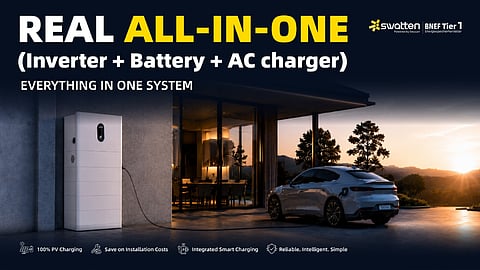

Swatten promoted its All-in-one sys-20 kWh-TH series 20 kW/25.6 kWh residential ESS
According to the company, its capacity can be scaled up to 20 kW/102.4 kWh by connecting 4 battery stacks, each of 25.6 kWh, in parallel
In terms of operation, it supports EV charging, self-consumption, ToU optimization, emergency backup, and VPP participation
SWATTEN, a subsidiary of Sieyuan Electric and an energy storage system (ESS) provider, highlighted its latest integrated energy storage system (ESS), All-in-one sys-20 kWh-TH, at Intersolar Europe 2026.
The company emphasized the integration of a built-in AC electric vehicle (EV) charger within a single cabinet that features a hybrid inverter, storage, battery management system (BMS), and energy management system (EMS). In contrast, the conventional ‘All-in-One’ storage system offers a hybrid inverter with a dedicated port that needs to be connected to an external EV charger. According to the company, this new integrated architecture helps end users plug the output port directly into the vehicle, without any additional purchase or installation. This also expands the integration level of the residential energy ecosystem.
On the PV side, the inverter supports up to 200% DC/AC PV oversizing compared to its rated 20 kW full-load AC capacity to maximize solar generation throughout the day. It is equipped with 3 MPPT channels, each with a voltage range of 150 to 950 V. This real-time PV generation is used to feed captive loads on priority, with any excess channeled to the storage system for additional self-consumption. The company states that the PV generation can also be fed directly into the AC EV charger. These complex real-time operations are monitored and controlled by the built-in EMS.
Its 25.6 kWh storage capacity is built with 8 lithium-iron-phosphate (LFP)-based battery stacks, each rated at 3.2 kWh and mounted on the others. This can be expanded to 102.4 kWh by connecting 4 stacks in parallel, making a 20 kW/102.4 kWh residential ESS platform. It switches to emergency backup mode within 4 ms of a grid outage and provides up to 20 kW backup power for up to 5 hours or until the cut-off voltage is reached.
In addition to self-consumption, PV-to-EV direct charging, and emergency backup, its EMS can schedule charging/discharging according to regional dynamic electricity tariffs or time-of-use (ToU) optimization. It can also be aggregated within a pool of distributed renewable energy sources and dispatch clean energy to the grid after receiving a signal from a virtual power plant (VPP) service provider.

