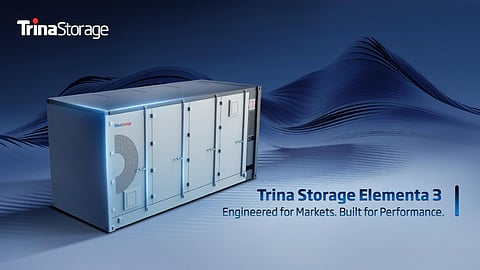

Trina Storage Solutions U.S., the US arm of Trinasolar’s energy storage systems (ESS) business unit, has launched its latest containerized product, Elementa 3, expanding the Elementa series portfolio. The company says this product has been designed and developed for the North American utility storage market, as well as a few selected global markets.
Compared to the previous model’s 314 Ah cells, the new product uses the new 587 Ah lithium iron phosphate (LFP) cells with an energy density of 417 Wh/L. The company notes that the product has optimized its cell assembly design for each battery unit. While this upgrade was not detailed in the press release, the company claims they result in up to 12.3% higher battery pack energy density. This higher density allows the company to fit 24 packs with a maximum capacity of 6.25 MWh in a compact container, compared with the immediate predecessor’s 32 units (5.025 MWh) within a 6,058 × 2,438 × 2,896 mm (L × W × D) space. The press release doesn’t reveal the BESS’s C-rate and full-load AC power; as such, the maximum rated continuous backup can’t be ascertained. The compact container size (dimensions unknown), which places exhaust and chillers at the top, can achieve up to 24.3% additional site-level energy density, in either back-to-back or side-by-side configurations, claims Trina Storage. However, it didn’t share the baseline utility capacities (kW/MWh) for this comparison with its peer (5.025 MWh). This site-level space-saving optimizes balance-of-system (BoS) costs while maintaining site accessibility for installers and operation & maintenance (O&M) providers.
From a safety perspective, this BESS features Negative Temperature Coefficient (NTC) sensors to detect a rapid temperature rise, a precursor to fire generation, within milliseconds. This early detection enables the system to take preventive measures to avoid potential system failure. The product also features a safety mechanism that automatically detects gas formation from internal combustion. This follows suppression of gas and prevents fire propagation.
On the operational flexibility side, the new storage system offers multiple utility ancillary services, including renewable energy firming, energy arbitrage, and grid stability.
Mr. Yang Bao, President of Trinasolar’s Energy Storage Division, said, “As markets move toward larger systems, wider application portfolios, and higher performance expectations, Elementa 3 is engineered to help project owners unlock greater economic returns, accelerate deployment, and operate with confidence even in the most challenging environments around the world.”

